Odisha News, Odisha Latest news, Odisha Daily - OrissaPOST
  • Home
  • Trending
  • State
  • Metro
  • National
  • International
  • Business
  • Feature
  • Entertainment
  • Sports
  • More..
    • Odisha Special
    • Editorial
    • Opinion
    • Careers
    • Sci-Tech
    • Timeout
    • Horoscope
    • Today’s Pic
  • Video
  • Epaper
  • News in Odia
  • Home
  • Trending
  • State
  • Metro
  • National
  • International
  • Business
  • Feature
  • Entertainment
  • Sports
  • More..
    • Odisha Special
    • Editorial
    • Opinion
    • Careers
    • Sci-Tech
    • Timeout
    • Horoscope
    • Today’s Pic
  • Video
  • Epaper
  • News in Odia
No Result
View All Result
OrissaPOST - Odisha Latest news, English Daily -
No Result
View All Result

Sun’s history hidden in Moon’s crust: NASA

Agencies
Updated: June 19th, 2019, 06:00 IST
in International
0
Share on FacebookShare on TwitterShare on WhatsAppShare on Linkedin

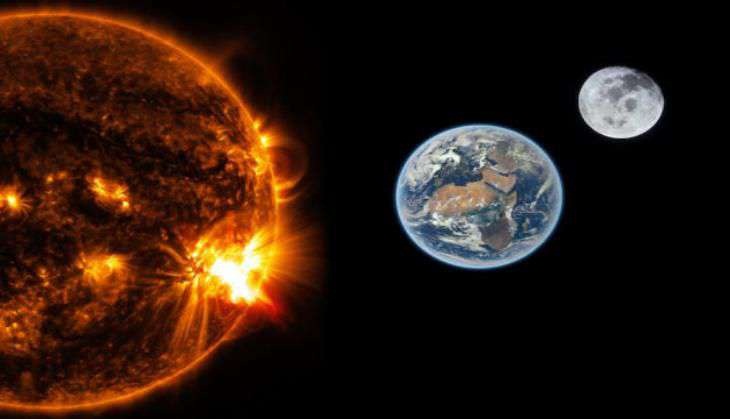
Washington, June 18: The Moon contains clues to the ancient mysteries of the Sun, which are crucial to understanding the development of life, according to NASA scientists, including one of Indian origin.

Around four billion years ago, the Sun went through violent outbursts of intense radiation, spewing scorching, high-energy clouds and particles across the solar system. These growing pains helped seed life on early Earth by igniting chemical reactions that kept Earth warm and wet, said researchers at NASA’s Goddard Space Flight Center in the US.


Also Read

PoK's JAAC rejects claims of Indian support for protests, seeks proof

PoK’s JAAC rejects claims of Indian support for protests, seeks proof

9 hours ago
Balen Shah

Nepal PM Balen Shah to hold separate meetings with Indian, Chinese envoys Monday

11 hours ago

These solar tantrums also may have prevented life from emerging on other worlds by stripping them of atmospheres and zapping nourishing chemicals, they said. Just how destructive these primordial outbursts were to other worlds would have depended on how quickly the early Sun rotated on its axis.

The faster the Sun turned, the quicker it would have destroyed conditions for habitability. This critical piece of the Sun’s history has bedeviled scientists, said Prabal Saxena, an astrophysicist at NASA’s Goddard Space Flight Center.

“We didn’t know what the Sun looked like in its first billion years, and it’s super important because it likely changed how Venus’ atmosphere evolved and how quickly it lost water,” said Saxena. “It also probably changed how quickly Mars lost its atmosphere, and it changed the atmospheric chemistry of Earth,” he said.

Saxena wondered why there is significantly less sodium and potassium in lunar regolith, or Moon soil, than in Earth soil, when the Moon and Earth are made of largely the same stuff. This question, revealed through analyses of Apollo-era Moon samples and lunar meteorites found on Earth, has puzzled scientists for decades — and it has challenged the leading theory of how the Moon formed.

Our natural satellite took shape, the theory goes, when a Mars-sized object smashed into Earth about 4.5 billion years ago. The force of this crash sent materials spewing into orbit, where they coalesced into the Moon. “The Earth and Moon would have formed with similar materials, so the question is, why was the Moon depleted in these elements?” said Rosemary Killen, a planetary scientist at NASA.

The two scientists suspected that one big question informed the other — that the history of the Sun is buried in the Moon’s crust. Saxena incorporated the mathematical relationship between a star’s rotation rate and its flare activity. This insight was derived by scientists who studied the activity of thousands of stars discovered by NASA’s Kepler space telescope.

They found the faster a star spins, the more violent its ejections. “As you learn about other stars and planets, especially stars like our Sun, you start to get a bigger picture of how the Sun evolved over time,” Saxena said.

Using sophisticated computer models, Saxena, Killen and colleagues think they may have finally solved both mysteries. Their computer simulations, described in the The Astrophysical Journal Letters, show that the early Sun rotated slower than 50 per cent of baby stars.

According to their estimates, within its first billion years, the Sun took at least nine to 10 days to complete one rotation. They determined this by simulating the evolution of our solar system under a slow, medium, and then a fast-rotating star.

The team found that just one version — the slow-rotating star — was able to blast the right amount of charged particles into the Moon’s surface to knock enough sodium and potassium into space over time to leave the amounts we see in Moon rocks today. “Space weather was probably one of the major influences for how all the planets of the solar system evolved, so any study of habitability of planets needs to consider it,” Saxena said.

The rotation rate of the early Sun is partly responsible for life on Earth. However, for Venus and Mars — both rocky planets similar to Earth — it may have precluded it. Earth’s atmosphere was once very different from the oxygen-dominated one we find today.

When Earth formed 4.6 billion years ago, a thin envelope of hydrogen and helium clung to our molten planet. However, outbursts from the young Sun stripped away that primordial haze within 200 million years.

As Earth’s crust solidified, volcanoes gradually coughed up a new atmosphere, filling the air with carbon dioxide, water, and nitrogen. Over the next billion years, the earliest bacterial life consumed that carbon dioxide and, in exchange, released methane and oxygen into the atmosphere.


 

ShareTweetSendShare
Suggest A Correction

Enter your email to get our daily news in your inbox.


Mettle Meet 2026
OrissaPOST epaper Sunday POST OrissaPOST epaper

Click Here: Plastic Free Odisha

#MyPaperBagChallenge

Pragyan Priyambada

December 12, 2019
#MyPaperBagChallenge

Geetanjali Patro

December 12, 2019
#MyPaperBagChallenge

Subhajyoti Mohanty

December 12, 2019
#MyPaperBagChallenge

Surya Sidhant Rath

December 12, 2019
Aravalli committee
#MyPaperBagChallenge

Vanavasi Kalyan Ashram seeks 2-month extension for Aravalli committee deadline

New Delhi: The Akhil Bharatiya Vanavasi Kalyan Ashram has sought that the chairperson of the high-powered committee constituted under the ...

August 8, 2026
#MyPaperBagChallenge

Ankita Balabantray

December 12, 2019
#MyPaperBagChallenge

Smitarani Sahoo

December 12, 2019
#MyPaperBagChallenge

Ipsita

December 12, 2019
#MyPaperBagChallenge

Tapaswini Mallick

December 12, 2019
?????????????????????????????????????????????????????????????????????????????????????????????????????????????????????????????????
#MyPaperBagChallenge

Dibya Ranjan Das

December 12, 2019
#MyPaperBagChallenge

Manas Samanta

December 12, 2019
#MyPaperBagChallenge

Pratik Kumar

December 12, 2019
#MyPaperBagChallenge

Bijswajit Pradhan

December 12, 2019
#MyPaperBagChallenge

Anup Mahapatra

December 12, 2019
#MyPaperBagChallenge

Parbati Mohanty

December 12, 2019
#MyPaperBagChallenge

Sitakanta Mohanty

December 12, 2019
#MyPaperBagChallenge

Shreyanshu Bal

December 12, 2019
#MyPaperBagChallenge

Nishikant Rout

December 12, 2019
#MyPaperBagChallenge

Arya Ayushman

December 12, 2019
#MyPaperBagChallenge

Rajashree Manasa Mohanty

December 12, 2019
#MyPaperBagChallenge

Priyabrata Mohanty

December 12, 2019
#MyPaperBagChallenge

Faiza Firdous

December 12, 2019
#MyPaperBagChallenge

Diptiranjan Biswal

December 12, 2019
#MyPaperBagChallenge

Priyasha Pradhan

December 12, 2019
#MyPaperBagChallenge

Mandakini Dakua

December 12, 2019
#MyPaperBagChallenge

Archana Parida

December 12, 2019
#MyPaperBagChallenge

Sibarama Khotei

December 12, 2019
#MyPaperBagChallenge

Pitabas Tripathy

December 12, 2019
#MyPaperBagChallenge

Rajashree Pravati Mohanty

December 12, 2019
#MyPaperBagChallenge

Matrumangal Jena

December 12, 2019

Archives

Editorial

Protect the Protest

Aakar Patel
August 9, 2026

By Aakar Patel There was a remarkable exchange in the Delhi High Court this week. The government was asked why...

Read moreDetails

Mandi House Reset

DILIP CHERIAN
August 8, 2026

By Dilip Cherian How an Education Ministry worthy wins a new post will be a tale told later. But for...

Read moreDetails

ISI After NEET

August 5, 2026

The Centre is courting yet another controversy by introducing a Bill in the Lok Sabha that seeks to fundamentally alter...

Read moreDetails

A Quiet Shift

Prashant Kishor
August 4, 2026

Change rarely arrives announced. But when a popular movement stirs, transformation can sweep in like a tide. The recent by-election...

Read moreDetails
  • Home
  • State
  • Metro
  • National
  • International
  • Business
  • Editorial
  • Opinion
  • Sports
  • About Us
  • Advertise
  • Contact Us
  • Jobs
Developed By Ratna Technology

© 2025 All rights Reserved by OrissaPOST

  • News in Odia
  • Orissa POST Epaper
  • Video
  • Home
  • Trending
  • Metro
  • State
  • Odisha Special
  • National
  • International
  • Sports
  • Business
  • Editorial
  • Entertainment
  • Horoscope
  • Careers
  • Feature
  • Today’s Pic
  • Opinion
  • Sci-Tech
  • About Us
  • Contact Us
  • Jobs

© 2025 All rights Reserved by OrissaPOST

    • News in Odia
    • Orissa POST Epaper
    • Video
    • Home
    • Trending
    • Metro
    • State
    • Odisha Special
    • National
    • International
    • Sports
    • Business
    • Editorial
    • Entertainment
    • Horoscope
    • Careers
    • Feature
    • Today’s Pic
    • Opinion
    • Sci-Tech
    • About Us
    • Contact Us
    • Jobs

    © 2025 All rights Reserved by OrissaPOST