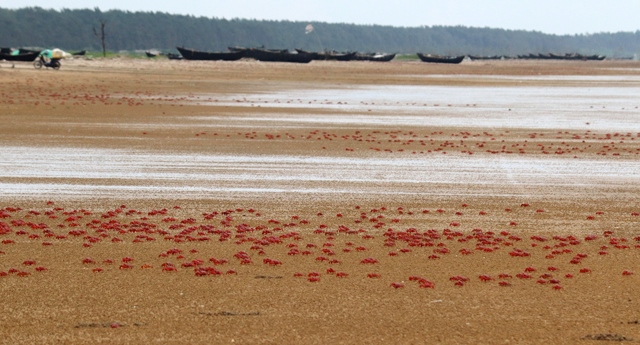
Balasore: The movement of red crabs along the seashore adds to the natural beauty of Balasore’s beaches and remains a major attraction for tourists.
Their playful scurrying across the sand draws visitors from morning till evening, packing the beaches with onlookers eager to witness the sight.


However, the population of these fragile creatures is steadily declining due to unregulated vehicular movement on beaches, dumping of waste and effluents into seawater and the impact of climate change, environmentalists said.
Red crabs significantly contribute to the environment by aerating soil and improving nutrient cycling through decomposition. They are also an important food source for marine life.
Also Read: Opposition blames BJP government after lynching case in Balasore
Odisha has a coastline stretching over 480 km. Beaches in Balasore district including Chandipur, Dublagadi, Dagara, Talasari and Udaypur, are particularly known for their scenic beauty, marked by dense casuarina plantations and vast sandy stretches where red crabs are commonly found.
Tourists travel from far-off places to experience this unique natural spectacle.
These crabs live in small burrows dug into the sandy beach. Activists alleged that the illegal felling of casuarina trees along the coast and their rampant transportation by tractors on the beaches have severely damaged crab habitats.
Continuous movement of tractors, fishing activities close to the shore and trampling of crab burrows during illegal collection of shells and other marine resources are causing the species to perish in large numbers.
Locals and environmentalists said a lack of awareness and poor enforcement of coastal protection norms are accelerating the decline in the population of red crabs, calling for immediate steps to regulate beach traffic and protect their natural habitat.
Experts have warned that chemical contamination is increasingly turning seawater toxic along the coast, threatening marine life.
Discharge of chemical-rich wastewater and industrial effluents into the sea, coupled with dumping of garbage and plastic waste into rivers and streams that drain into the ocean, is severely degrading water quality.
The presence of microplastics in seawater is also rising, with serious consequences for marine ecosystems.
“The increasing presence of chemicals and microplastics is reducing the reproductive capacity of marine organisms,” said scientist Siddhartha Pati.
“As a result, there is a growing threat of extinction of several marine species, including red crabs.”
Experts also pointed out that the population of red crabs along the Odisha coast has not yet been scientifically estimated.
Visual observation alone cannot provide an accurate assessment of any species’ population, they said.
“In biodiversity studies, every organism acts as a biological indicator,” said Biswajit Panda, founder of the development organisation Vikash Sathi.
“A decline, increase or migration of any species raises serious questions about environmental balance.”
Environmentalists have called for scientific monitoring, stricter regulation of industrial discharge and effective management of plastic waste to prevent further damage to marine ecosystems.