

Brisbane: A fossil hippo tooth is an unlikely find in the middle of a desert. The vast sandy expanse of Arabia’s Empty Quarter or Rub’al Khali stretches across the southern part of the peninsula, covering parts of Saudi Arabia, Oman, Yemen and the United Arab Emirates. Yet its ancient sands preserve evidence of a very different landscape. Approximately 125,000 years ago, the Mundafan basin in southern Saudi Arabia supported a freshwater lake surrounded by grasslands.
The lake provided a suitable habitat for hippos, while giant buffalo, gazelles, oryx and ostriches inhabited the surrounding landscape. Early humans also occupied the area, leaving behind thousands of stone tools that provide valuable evidence of their daily activities, hunting practices and knowledge of natural resources. A recent study published in Science has revealed significant details about how these early human populations made hunting weapons, processed plants and used poisonous substances to hunt animals. The findings offer important insights into human life during an early phase of migration beyond Africa and demonstrate how people adapted to environments that have since become desert landscapes. Modern humans originated in Africa approximately 300,000 years ago. However, archaeological and fossil evidence suggests that Homo sapiens began moving beyond the continent much earlier than previously understood. Fossils discovered in Greece and Israel indicate human presence outside Africa around 200,000 years ago, while a human finger bone found in northern Arabia suggests that Homo sapiens occupied the Arabian Peninsula at least 85,000 years ago. Arabia served as an important geographical connection between Africa and Asia.
During wetter climatic periods, the region experienced the development of lakes, rivers and grasslands, creating favourable conditions for human settlement. These environmental changes, often described as the period of Green Arabia, enabled different human populations to occupy areas that are now dominated by deserts. An international research team investigated the archaeological site of ‘Uruq Aljeli bah, located near the ancient Mundafan lake.
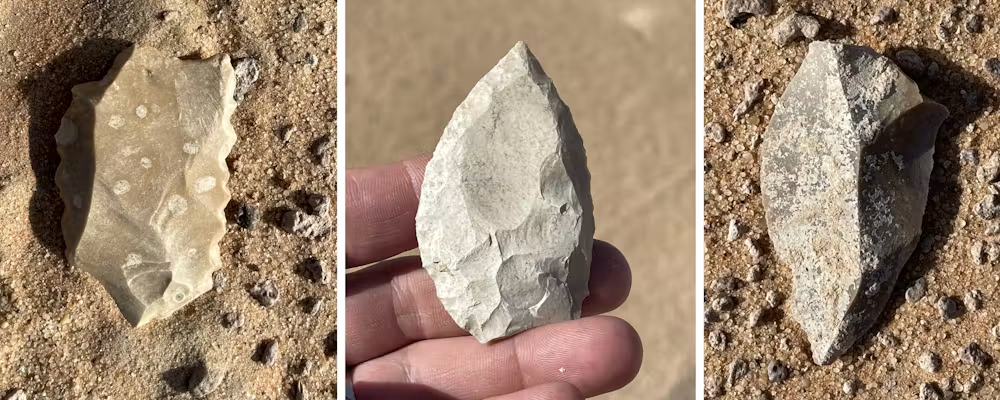
Researchers recovered more than 5,500 stone tools and fragments, alongside animal fossils. Scientific dating techniques established that the ancient lakeshore existed approximately 125,000 years ago. Microscopic examinations revealed that several stone points had damaged tips, indicating their use in hunting. One particular stone point contained resin and plant fibres, suggesting that it had been attached to a wooden shaft using natural adhesives. Animal fats and proteins were also identified near its tip. Chemical analysis further identified traces associated with the arrow-poison tree, which contains substances capable of affecting the heart. These findings suggest that early humans used poisonous plants to improve their hunting effectiveness. This evidence places poison-assisted hunting approximately 65,000 years earlier than previously reported examples from South Africa. The study also identified traces of leaves, wood, bark, palm fibres, reeds and underground plant materials on several tools. Wear patterns suggested that toothed stone implements were used to cut, saw and shred plants.
These materials may have been used to manufacture bindings, weapon components, cords and containers. Animal fossils indicate that Mundafan supported a diverse ecosystem with freshwater habitats and open grasslands. However, changing climatic conditions eventually caused the lake to disappear, forcing the landscape to become increasingly dry. Although the destination of its inhabitants remains unknown, their tools demonstrate considerable knowledge of local plants, animals and hunting techniques. The discoveries therefore provide valuable evidence of early human innovation and environmental adaptation.
Orissa POST – Odisha’s No.1 English Daily