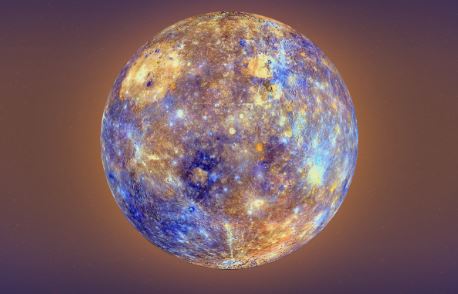
Milton Keynes (England): Planetary scientists have long known that Mercury has been shrinking for billions of years. Despite being the closest planet to the Sun, its interior has been cooling down as internal heat leaks away. This means that the rock (and, within that, the metal) of which it is composed must have contracted slightly in volume.
It is unknown, however, to what extent the planet is still shrinking today – and, if so, for how long that is likely to continue. Now our new paper, published in Nature Geoscience, offers fresh insight.


Because Mercury’s interior is shrinking, its surface (crust) has progressively less area to cover. It responds to this by developing “thrust faults” – where one tract of terrain gets pushed over the adjacent terrain.
This is like the wrinkles that form on an apple as it ages, except that an apple shrinks because it is drying out whereas Mercury shrinks because of thermal contraction of its interior.
The first evidence of Mercury’s shrinkage came in 1974 when the Mariner 10 mission transmitted pictures of kilometres-high scarps (ramp-like slopes) snaking their way for hundreds of kilometres across the terrain.
Messenger, which orbited Mercury 2011-2015, showed many more “lobate scarps” (as they had become known) in all parts of the globe.
From such observations, it was possible to deduce that gently dipping geological faults, known as thrusts, approach the surface below each scarp and are a response to Mercury having shrunk in radius by a total of about 7km.
But when did this happen?
The accepted way to work out the age of Mercury’s surface is to count the density of impact craters. The older the surface, the more craters. But this method is tricky, because the rate of impacts that produce craters was much greater in the deep past.
However, it was always clear that Mercury’s scarps must be fairly ancient, because although they cut through some older craters, quite a few younger craters are superimposed upon the scarps and so the scarps must be older than those.
When did that scarp last move?
The consensus view is that Mercury’s scarps are mostly about three billion years old. But are all of them that old? And did the older ones cease moving long ago or are they still active today?
We should not expect that the thrust fault below each scarp has moved only once. The biggest earthquake on Earth in recent years, the magnitude 9 Tohoku earthquake offshore of Japan in 2011 which caused the Fukushima disaster, was the result of a sudden jump by 20 metres along a 100km length of the responsible thrust fault.
Mercury’s biggest “earthquakes” are probably smaller. To accumulate the 2-3km of total shortening that can be measured across a typical scarp on Mercury would take hundreds of magnitude 9 “earthquakes”, or more likely millions of smaller events, which could have been spread out over billions of years.
Getting a handle on the scale and duration of fault movements on Mercury is important, because we would not expect Mercury’s thermal contraction to have entirely finished, even though this should be slowing down.
Cracking up
Until now, evidence has been sparse. But our team found unambiguous signs that many scarps have continued to move in geologically recent times, even if they were initiated billions of years ago.
This work was triggered when a PhD student at Open University in the UK, Ben Man, noticed that some scarps have small fractures piggy-backing on their stretched upper surfaces. He interpreted these as “grabens”, the geological word to describe a strip of ground dropped down between two parallel faults.
This typically happens when the crust is stretched. Stretching may seem surprising on Mercury, where overall the crust is being compressed, but Man realised that these grabens would occur if a thrust slice of crust has been bent as it is pushed over the adjacent terrain. If you try to bend a piece of toast, it may crack in a similar way.
The grabens are less than 1km wide and less than about 100 metres deep. Such comparatively small features must be much younger than the ancient structure on which they sit, otherwise they would have already been erased from view by impacts tossing material across the surface in a process aptly named “impact gardening”.
Based on the rate of blurring resulting from impact gardening, we calculated that the majority of grabens are less than about 300 million years old. This suggests that the latest movement must have happened equally “recently”.
Working with the most detailed images provided by MESSENGER, Man found 48 large lobate scarps that definitely have small grabens. A further 244 were topped by “probable” grabens – which aren’t seen quite clearly enough on the best MESSENGER images.
These are now prime targets for confirmation by the imaging system of the joint European/Japanese BepiColombo mission, which should start operating in orbit around Mercury early in 2026.
Lessons from the Moon
The Moon has also cooled and contracted. Its lobate scarps are considerably smaller and less spectacular than those on Mercury, but on the Moon we know for sure that as well as being geologically recent, some are active today.
This is because recent reanalysis of the locations of moonquakes recorded by seismometers (vibration detectors) left on the Moon’s surface by several Apollo missions shows that moonquakes are clustered close to lobate scarps.
Also, the most detailed images of the Moon’s surface from orbit reveal the tracks made by boulders bouncing down scarp faces, presumably after being dislodged by moonquakes. Much smaller in scale than Mercury’s grabens, similar logic applies to these boulder tracks: they would become erased from visibility after only a few million years, so they must be young.
BepiColombo won’t be landing and so we have no prospect of collecting any seismic data on Mercury. However, as well as showing small grabens more clearly, its most detailed images might reveal boulder tracks that could be additional evidence of recent quakes. I am looking forward to finding out.
By David Rothery, Professor of Planetary Geosciences, The Open University
The Conversation