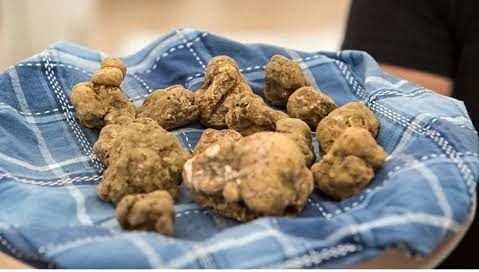
Alba: In the hills around Alba, home to the world’s most famous white truffles, hunters known as “trifolau” traditionally begin their season October 1.
But increasingly, they are confronting a challenge above ground: climate change.

“The entire month of October was affected by the lack of rain in July and August and the high temperatures, so it was characterised by poor production and poor truffle shelf life,” said Antonio Degiacomi, president of Italy’s National Centre for Truffle Studies.
According to Degiacomi, dry and compacted soils have also produced smaller truffles this season.
The difficult harvest comes as Alba and the surrounding Langhe hills welcome visitors for the International White Truffle Fair, one of Italy’s best-known food events, which opened October 10 and runs until December 6.
Similar concerns are emerging elsewhere in Europe’s truffle-producing regions, suggesting a challenge extending beyond any single forest or region.
Across the Adriatic in Croatia, truffle hunters and scientists describe many of the same challenges, from shrinking harvests to declining habitat suitability.
In oak forests outside Zagreb, truffle hunter Petar Alebic says years of drought have made the prized fungi harder to find.
“Each year for the past seven or eight years has been worse than the last,” Alebic said. “Due to the drought, unfortunately, truffles are becoming smaller and scarcer.”
Alebic estimates this year’s harvest is about 30 per cent below normal and increasingly supplements his income with truffle-hunting tours for tourists.
Scientists studying truffles in Croatia report similar findings. Croatia is home to about a dozen truffle species, according to mycologist Armin Mesic of the Rudjer Boskovic Institute.
The most prized, the white truffle, can fetch as much as 4,000 euros ($4,500) per kilogram. “Drought, a lack of rainfall and high temperatures have a significant impact on both the quantity and quality of truffles,” Mesic said.
“Quantities are declining, as is the geographical area where white truffles grow,” he added. Yet experts in Piedmont reject the idea that the white truffle is doomed.
Researchers are studying ways to help truffle habitats adapt, including improved forest management and experimental irrigation during prolonged droughts.
Researchers are also investigating the role of soil microorganisms and looking for tree varieties better suited to hotter and drier conditions.