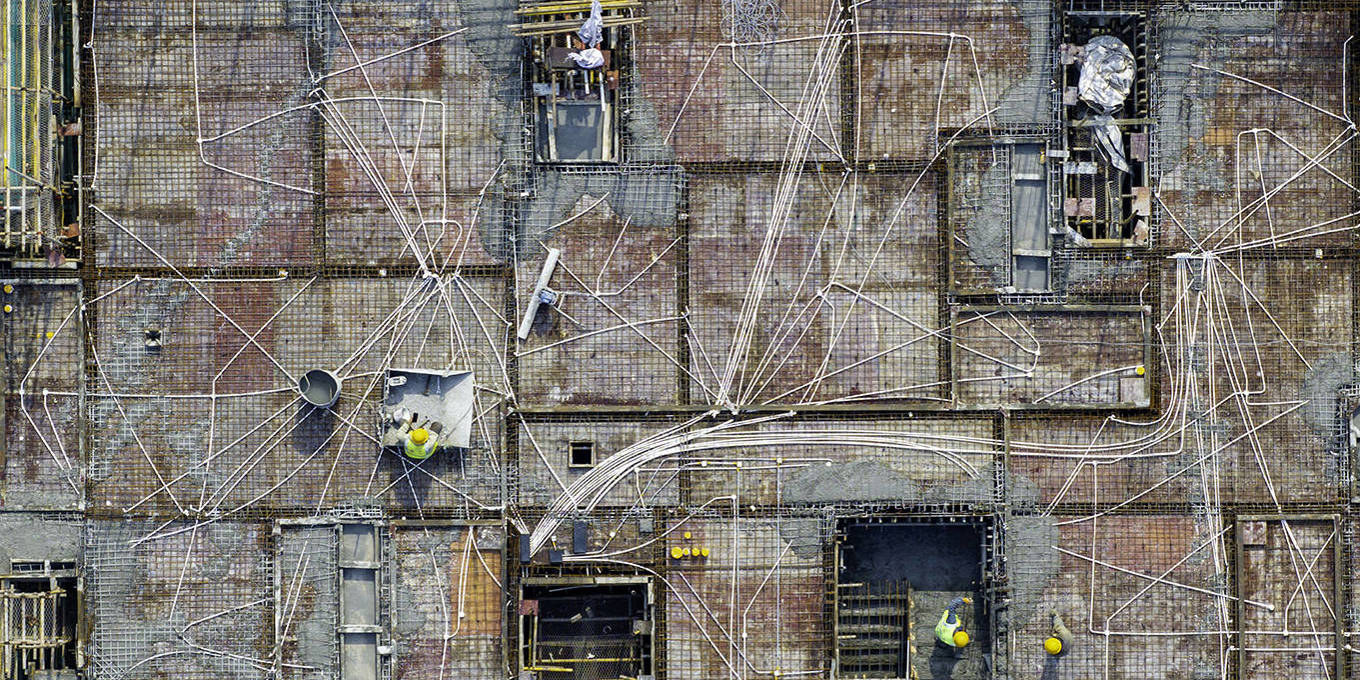
Infrastructure investment is booming. Around the world, governments are pouring trillions of dollars into roads, power grids, data centres, water systems, and housing, with many responding to intensifying climate shocks and the growing need for adaptation. Yet the construction industry – the single largest force physically reshaping the planet – is among the last major sectors to unlock all the benefits that digital technology offers. As a result, it accounts for about 21% of greenhouse-gas emissions, produces half of global landfill waste, and overspends by $1.6 trillion a year.
This must change, and AI may offer the solutions that the industry needs. But that will require fully leveraging the potential of institutional collaboration and human networks. While generative AI can write code or summarise documents, building real-world assets like bridges and power grids requires what we might call “cognitive infrastructure”: difficult-to-access data, human expertise, domain knowledge, and institutions through which to deploy new tools for planning and delivery. Like electricity without a power grid, AI without this foundation will remain a source of untapped potential.


What would leveraging AI look like in practice? For starters, it would require unlocking and integrating siloed data from thousands of stakeholders, including construction firms, suppliers, government ministries, multilateral agencies, and financiers. It would also involve codifying domain knowledge from past project cycles to understand why delays happen, how risks compound, and where capacity breaks down; and building intelligent digital agents that understand infrastructure-specific workflows (contracting, procurement, permitting, and budgeting). But most importantly, it would demand institutional collaboration. We do not need static roadmaps, but rather dynamic, evolving feedback mechanisms. AIs for infrastructure would learn from every project and apply lessons across organisations. The opportunity to improve how we build things comes just as the geopolitics of infrastructure is shifting. As President Donald Trump seeks to reverse all his predecessor’s clean-energy policies, others are filling the leadership vacuum the United States has created. China, for example, has reoriented its Belt and Road Initiative toward “green, high-quality” development, pairing massive overseas transportation and energy investments with climate-resilience projects at home.
Similarly, Saudi Arabia, long synonymous with hydrocarbons, has launched a “green initiative” to funnel tens of billions of dollars to support solar and wind projects, green finance frameworks, and new public-private partnerships. And India has already hit its target of commit ting 50% of its installed power capacity to non-fossil sources. It has also launched a National Green Hydrogen Mission, targeting annual production of five million tons by 2030, and has used global platforms such as the G20 and the United Nations Climate Change Conference to champion climate-resilient infrastructure and “green development pacts.”
The result is a fragmented map. While the world’s largest historical emitter is doubling down on fossil-fuel exports, emerging and middle-income economies are increasingly presenting themselves as voices of climate responsibility. In this new landscape, the contest is not only over whose capital builds the next generation of ports, grids, and railways, but whose data, standards, and AI systems will guide those investments.
The next leader in infrastructure will focus on three immediate priorities. The first is to make the most of available data. Infrastructure know-how tends to be buried in PDFs, contracts, and permit files. Governments, banks, and companies must uncover this hidden history to help all stakeholders avoid past mistakes and navigate new policy settings when governments abruptly rewrite the rules (as the US has done).
The second priority is to build AI tools for this specific purpose. What we need is not a generic chatbot, but models trained on materials science, logistics, and local regulations. An AI that understands why projects fail can make success more likely.
Lastly, we must do a better job of sharing knowledge across borders. Instead of having each institution reinvent the wheel, we need a shared knowledge base so that lessons from a dam in India or a metro in Paris can improve projects everywhere.
Over the next decade, infrastructure will define not just climate adaptation, but global competitiveness. It is the muscle of the real economy. The countries that align their climate commitments, industrial policies, and infrastructure pipelines with credible, data-driven intelligence will set the rules of the game for everyone. Those who weaponise uncertainty, or treat sustainable infrastructure as an afterthought, will find their influence eroding.
AI should not be seen as a centralised oracle or as an abstract mind in the cloud. Its real uses lie in targeted applications to connect real-world projects, institutional workflows, and human networks. That is the kind of intelligence that will build not just better roads and resilient grids, but also more effective and efficient systems and organisations.