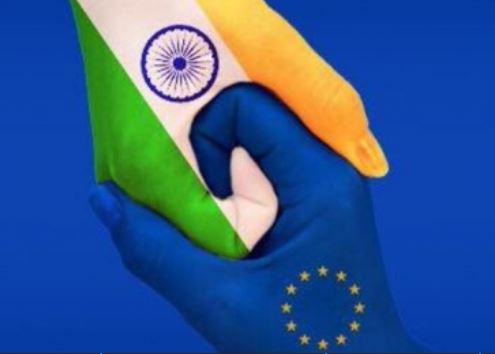
New Delhi: India and the European Union Tuesday sealed a landmark free trade agreement — billed as “mother of all deals” — with Prime Minister Narendra Modi and the top EU leadership unveiling a grand agenda to leverage trade and defence to shore up ties amid a fractious world order.
The two sides also inked two crucial pacts — one on security and defence collaboration and another on the mobility of Indian talent to Europe — after Prime Minister Modi hosted EU leaders Ursula von der Leyen and Antonio Costa for summit talks.

In line with their vision for a rules-based global order, India and the 27-nation bloc rolled out a joint comprehensive strategic agenda for the next five years and firmed up a total of 13 pacts including one on the conclusion of negotiations for the FTA.
In his remarks, Modi said the global order is in “great turmoil” and in such a context, the partnership between India and the EU will strengthen stability in the international system.
“Today India has concluded the biggest free trade agreement in its history.
“It will facilitate access to the European market for our farmers and small industries, create new opportunities in manufacturing and services sectors,” PM Modi said in his media statement.
“This FTA will boost investment between India and the European Union, create new innovation partnerships and strengthen supply chains globally. This means it is not just a trade agreement. This is a new blueprint for shared prosperity,” he said.
The finalisation of the trade deal came 18 years after the two sides began negotiations on it. It may take at least six months to formally sign the deal as it will require legal scrubbing by both sides.
Hailing the mega trade deal, European Commission President von der Leyen said the India-EU partnership will send a strong message that cooperation is the best answer to global challenges, in remarks that came amid growing strain in ties between Europe and the US.
“We did it. We delivered the mother of all deals. We are creating a market of two billion people,” she said.
“And this is the tale of two giants, the world’s second and fourth largest economies, two giants who choose partnership in a true win-win fashion, a strong message that cooperation is the best answer to global challenges,” she said.
Von der Leyen said the trade deal will cut up to 4 billion euros in annual tariffs for European exporters of all sizes and will create jobs for millions of workers both in India and Europe.
The EU, as a bloc, is India’s largest trading partner in goods. For the financial year 2024-25, India’s total trade in goods with the EU was worth about USD 136 billion, with exports around USD 76 billion and imports at USD 60 billion.
“It (FTA) brings together Indian skills, services and scale with Europe’s technology, capital and innovation. It will create levels of growth that neither side can achieve alone,” Von der Leyen said.
“And by combining these strengths, we reduce strategic dependencies at a time when trade is increasingly weaponised,” she said in an apparent reference to the Trump administration’s policies on trade and tariffs.
Von der Leyen, referring to the defence partnership pact, said Europe and India have chosen to be reliable partners to one another.
“We are not only making our economies stronger, we are also delivering security for our people in an increasingly insecure world. And today, the world’s two largest economies and democracies launched their first-ever security and defence partnership,” she said.
“This is a landmark departure and a trust-based platform for cooperation on the strategic issues that matter most. In doing so, we will help to build each other’s resilience,” she added.
In his remarks, European Council President Costa said the key agreements signed between the two sides will reinforce the rules-based global order.
“Trade agreements reinforce rules-based economic order and promote shared prosperity. That’s why today’s free trade agreement is of historic importance — one of the most ambitious agreements ever concluded, creating a market of two billion,” he said.
In a multi-polar world, Costa added, the European Union and India are working together to grow spheres of shared prosperity.
“But prosperity does not exist without security. We will strengthen our cooperation to better protect our citizens and our shared interests, working together to counter the full range of security threats we face in the Indo-Pacific, in Europe and around the world, reaching a new level of strategic trust between us,” he said.
In his comments, Modi said the India-EU comprehensive strategic agenda will provide a “clear direction” and advance shared prosperity by accelerating innovation, strengthening security cooperation and deepening people-to-people ties.
“India and the European Union’s cooperation is a partnership for global good. We will expand trilateral projects from the Indo-Pacific to the Caribbean,” he said.
“Together, we will establish the IMEC corridor as a key link between global trade and sustainable development,” he said.
Modi said both sides discussed in detail a number of global issues, including the situation in Ukraine, West Asia and the Indo-Pacific.
“Multilateralism and respect for international norms are our shared priorities. We are unanimous that reform of global institutions is essential to address today’s challenges,” he said.
The European Council president also reiterated Europe’s long-held position on Ukraine.
“Peace will not come out of a clash of arms, but out of justice lived and done by unarmed nations in the face of odds.”
“Our summit reaffirmed our commitment to supporting efforts towards a comprehensive, just and lasting peace in Ukraine, one that fully respects Ukraine’s independence, sovereignty and territorial integrity,” he said.
“This is a key moment. We are supporting all efforts to reach a just and sustainable peace. Ukraine has shown its readiness, including at the cost of a difficult compromise,” he said.
Costa said Europe is also counting on PM Modi to help in creating conditions for peace through dialogue and diplomacy.
“Together, we must show leadership on global issues. Cooperation between the European Union and India will help shape a more balanced, resilient and inclusive global order,” he said.