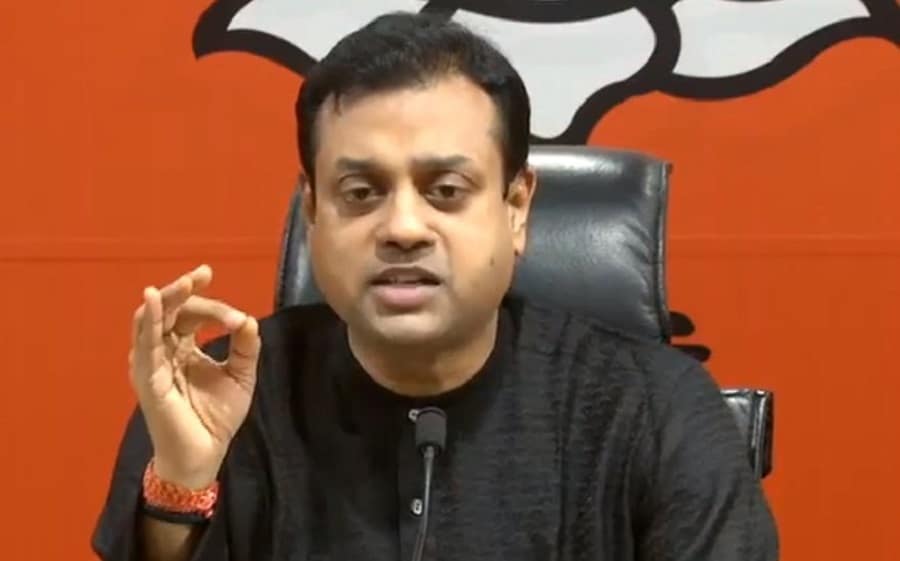
Bhubaneswar: BJP MP from Puri Dr Sambit Patra has strongly defended the amended Mines and Minerals (Development and Regulation) Act, dismissing Opposition allegations that the legislation would undermine the federal structure and curtail States’ powers to collect mineral-related revenue as “completely baseless and false”.
Patra asserted that the amended MMDR Act was in the interest of Odisha and its people and rejected the Opposition’s claim that the State had suffered a loss of Rs 1 lakh crore because of the legislation.

He alleged that Odisha had lost around Rs 62,000 crore in revenue arrears because the previous BJD government failed to make necessary legal amendments and allowed the matter to remain pending for 18 years.
“States have every right to recover old tax arrears. But when the appropriate law was not enacted and the ORISED Act was under judicial consideration, on what basis could the arrears have been recovered?” Patra asked.
He said recovery of arrears merely on the basis of a policy, without the necessary legal framework, was impossible.
“Recovering arrears solely on the basis of a policy without a legal framework is like having the bowl but no pakhala. In the absence of the necessary legal amendment, actual recovery of the tax was impossible,” he said.
The MMDR Act was enacted in 1957 to regulate mining in the country and underwent major reforms in 2015 after the Narendra Modi-led government came to power at the Centre in 2014, he added.
He claimed that before the 2015 reforms, mining had become synonymous with “corruption and theft”, with allegations of favouritism, nepotism and lack of transparency in the allocation of mines.
The introduction of the e-auction system in 2015 brought greater transparency to mineral allocation and resulted in a sharp increase in Odisha’s mining revenue, he said.
Patra claimed that Odisha’s annual mining revenue, which stood at around Rs 3,300 crore to Rs 5,000 crore before 2014-15, had risen nearly tenfold after the reforms and had now reached between Rs 55,000 crore and Rs 60,000 crore.
He said the revenue was expected to increase further in the coming years.
The BJP MP said Odisha had received around Rs 37,000 crore after the creation of the District Mineral Foundation (DMF) and claimed that the auction premium had increased by 150 per cent since 2015, while royalty had risen from 10 per cent to 15 per cent.
“States like Odisha have benefited the most from the 2015 amendment to the MMDR Act,” he claimed.
Patra said the Odisha government had enacted the ORISED Act in 2004 to impose additional taxes on minerals such as bauxite and iron ore for the welfare of people in mining-affected areas, particularly tribals and the poor.
NALCO, a Central public sector undertaking, had challenged the ORISED Act when the Congress-led government was in power at the Centre, he said.
The Orissa High Court stayed the operation of the Act in December 2005. The then Odisha government subsequently filed a Special Leave Petition before the Supreme Court in 2006, which later became a civil suit and remained pending for 18 years until 2024, Patra said.
“What was their Advocate General doing? During this period, the High Court had given an opportunity to amend and restore the law. Why did the then BJD government fail to make the necessary amendments and in whose interest?” he questioned.
Patra referred to the July 25, 2024 judgment of the nine-judge Constitution Bench of the Supreme Court in the Mineral Area Development Authority (MADA) vs SAIL case, saying the court had held that States could recover arrears from defaulters for the specified period.
“We have our report with us. Those who are making false allegations against us should say how much money they have recovered,” he said.
Patra also cited the Shah Commission report of 2010, claiming that it had documented widespread irregularities in Odisha’s mining sector and that penalties of nearly Rs 60,000 crore had been imposed on mine owners for alleged mining violations.
He also referred to a 2017 Supreme Court judgment concerning environmental degradation and mining-related irregularities in mineral-rich districts including Kendujhar, Sundaragada and Mayurbhanj, saying the situation had caused immense hardship to tribal communities.
Despite the Centre providing Rs 16,000 crore under the DMF for Keonjhar, there had been little visible development in the district, he claimed.
He held the previous BJD government responsible for the situation and alleged that CAG reports had exposed large-scale diversion and misappropriation of DMF funds during the BJD regime.
Patra claimed that of more than Rs 983 crore, Rs 976 crore was spent in non-mining-affected villages, while 584 mining-affected villages were deprived of grants. He also alleged that 1,730 projects were implemented without approval from the Gram Sabhas, citing the CAG report.
“During the BJD rule, mineral-related tax revenue collected in large amounts was looted,” he alleged.
He said the Narendra Modi-led Central government was working for the welfare of poor, tribal and deprived sections of Odisha under the policy of “Sabka Saath, Sabka Vikas”.
Bhubaneswar BJP MP Aparajita Sarangi, who was present at the press conference, alleged that Odisha and its people had suffered a loss of around Rs 1,03,220 crore due to mismanagement during the BJD’s 25-year rule.
She said the Shah Commission report had mentioned a loss of Rs 60,000 crore between 2010 and 2013, while eight CAG audit reports had pointed to losses running into thousands of crores of rupees.
Sarangi alleged that the then BJD government had failed to effectively defend its position in the ORISED case, leading to the law being struck down by the High Court.
She termed the BJD’s protests and uproar following passage of the amended MMDR Act in Parliament as “highly ridiculous” and urged leaders of the BJD and Congress to repeatedly read and understand the amended legislation.