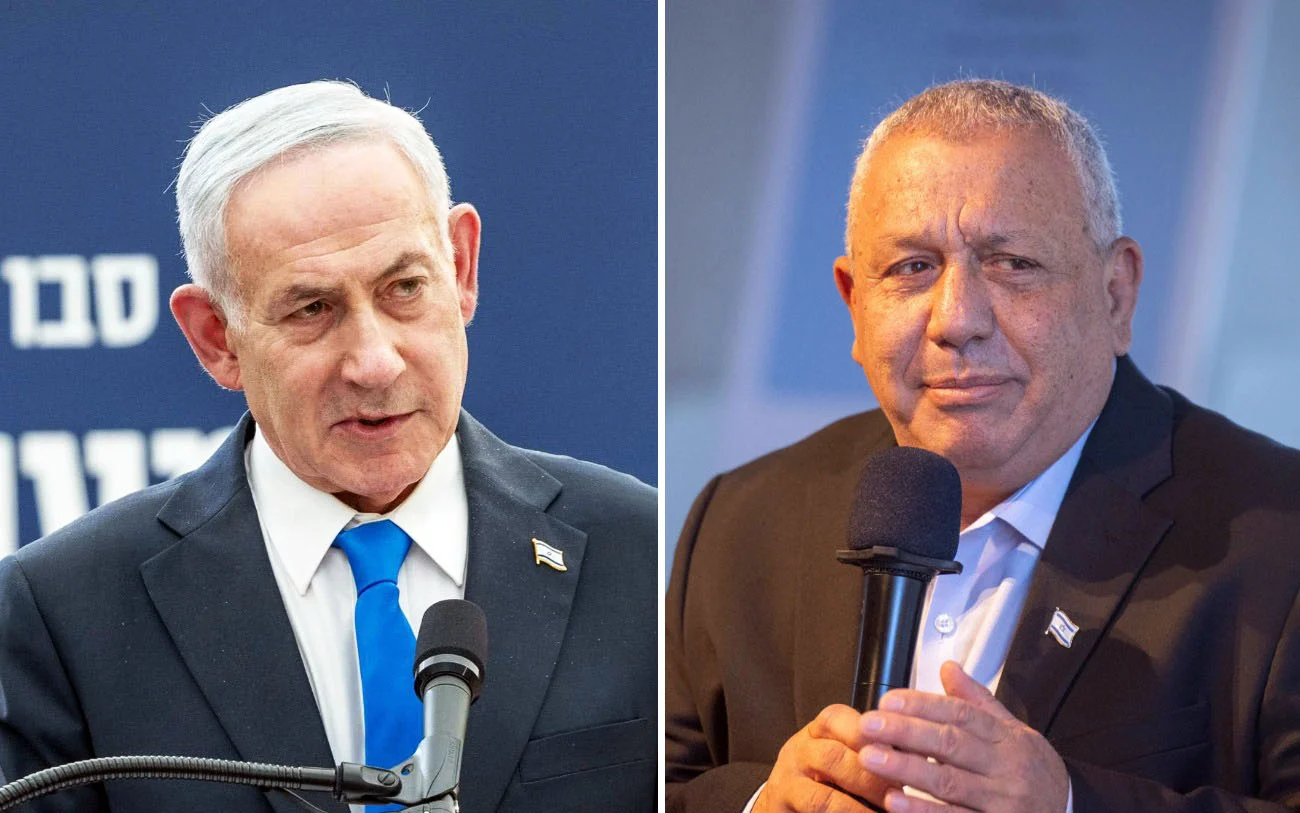
Jerusalem: Israeli Prime Minister Benjamin Netanyahu’s bloc remained short of a parliamentary majority as the latest partial election count gave it 53 seats, against 48 for the opposition bloc led by former military chief Gadi Eisenkot, while Arab-led parties were projected to win 19 seats, leaving the formation of the next government uncertain.
According to local media reports citing the Central Elections Committee (CEC), 93 per cent of ordinary ballots had been counted, accounting for 85.6 per cent of the total votes.

At least 61 seats are required for a majority in the 120-member Knesset, Israel’s parliament.
Eisenkot’s bloc and the Arab-led parties together have 67 seats in the current count, potentially giving them enough parliamentary support to form a government if they can overcome their political differences.
However, the prospect of such a government remains uncertain. Netanyahu has opposed relying on Arab-led parties, while opposition figures have differed over whether to include them in a coalition or depend on their support from outside.
The CEC said the remaining seven per cent of ordinary ballots required additional oversight.
Local media, citing the CEC, reported that about 600,000 double-envelope ballots also remained to be counted.
These include votes cast by soldiers and other eligible voters away from their registered polling stations, and were expected to be added to the tally over the next few days after checks to prevent duplicate voting.
Three parties remained below the electoral threshold of 3.25 per cent of valid votes Reservists, at 2.6 per cent; People of Israel, at 1.6 per cent; and Charedi Public, at 0.2 per cent. Their final vote shares could change as counting continues.
Exit poll projections by mainstream broadcasters had put Netanyahu’s bloc at 50-52 seats and the opposition bloc at 51-53, with Arab-led parties projected to win around 17-18 seats. An i24NEWS exit poll gave Netanyahu’s bloc 55 seats against 49 for Eisenkot’s bloc.
Netanyahu’s Likud party appeared on course to emerge as the largest individual party, although the wider bloc supporting him remained short of a majority.
President Isaac Herzog has urged political parties to make every effort to avoid another election, saying he expected those seeking to form a government to approach the process with an open mind.
“We must do everything we can, certainly after yesterday, to avoid another round of elections. So I expect everyone who comes here to come with an open mind,” Herzog said in Jerusalem.
Herzog said he expected to receive the official election results next week from Supreme Court Justice Noam Sohlberg. He would then begin consultations with each Knesset faction on the formation of a new government.
The president also praised the high turnout, describing it as a “badge of honour for Israeli society” and saying it demonstrated Israelis’ “desire for democracy”.
Turnout reached 77.7 per cent, the highest since 1999.
Netanyahu’s immediate challenge is to assemble a coalition that can command the support of at least 61 lawmakers.
The opposition bloc also falls short of that number on its own, leaving the Arab-led parties in a potentially influential position.
Netanyahu has warned against what he described as a “dangerous government” that might include Arab-led parties.
Yair Golan, leader of the Democrats party, urged Eisenkot’s bloc to form a government in partnership with Arab-led parties, arguing that their voters should have the same political weight as Jewish citizens.
Golan called for an end to what he described as racism and fear of political cooperation with Arab citizens, as he argued that the opposition could form a government of change in partnership with Arab citizens.
The disagreement over Arab-party cooperation remains a major obstacle to forming a government, even if the current seat distribution holds.
Arab-led parties have previously played a role in government formation. Ra’am, led by Mansour Abbas, joined the coalition formed in 2021 under then-prime minister Naftali Bennett and Yair Lapid. That government collapsed in 2022, triggering another election.
Eisenkot, 66, leads the Yashar party and has emerged as a central figure in the effort to replace Netanyahu, Israel’s longest-serving prime minister. After four decades in uniform, he is seeking to translate his military credentials into political power.
His political profile rose further after Hamas’ October 7, 2023, attack on Israel, in which around 1,200 people were killed and hostages were taken into Gaza.
Eisenkot joined the emergency war cabinet formed by Netanyahu as an observer, but left the emergency government in June 2024, criticising the absence of a clear strategy for the war and accusing Netanyahu of allowing political considerations to take precedence over security and the return of hostages.
The conflict has also affected his family. His son and two nephews were killed while serving in the military during the war. Eisenkot has pledged to establish a state commission of inquiry into the security failures surrounding the October 7 attack, while Netanyahu has resisted calls for such an inquiry during the conflict.
Eisenkot has campaigned on security, governance and a more disciplined approach to military decision-making.
The election has revived the possibility of a national unity government involving Netanyahu and Eisenkot, though the idea faces resistance from opposition parties.
Israel has experienced repeated electoral deadlock over the past decade, holding five elections between April 2019 and November 2022 amid prolonged disputes over Netanyahu’s leadership and the composition of a governing coalition.
In the 2022 election, the pro-Netanyahu bloc secured 64 seats, helped by the failure of Meretz and Balad to cross the electoral threshold.
Under Israel’s proportional representation system, voters choose closed party lists, with the entire country treated as a single constituency. Parties must secure at least 3.25 per cent of valid votes to win seats in the Knesset. Votes cast for parties that fail to cross the threshold do not translate into seats.
The current deadlock also recalls the power-sharing agreement reached in 2020 between Netanyahu and Benny Gantz, a former defence minister and military chief who served as IDF chief of staff from 2011 to 2015.
Under the agreement, Gantz was due to succeed Netanyahu as prime minister under a rotation arrangement. The government collapsed before the planned transfer of power after it failed to pass a state budget within the required deadline, triggering early elections.
The Central Elections Committee is required to publish the final election results by November 4, according to its official timetable.
Herzog will consult representatives of the elected parties before assigning a lawmaker the task of forming a government. The president generally selects the candidate considered best placed to secure parliamentary support, rather than being required to choose the leader of the largest party.
The first nominee has 28 days to form a government, with the president able to grant an extension of up to 14 days.
If that attempt fails, another lawmaker may be given an opportunity under the prescribed process. Failure to form a government could eventually lead to another election, with Netanyahu remaining prime minister in a caretaker capacity in the interim.
Orissa POST – Odisha’s No.1 English Daily