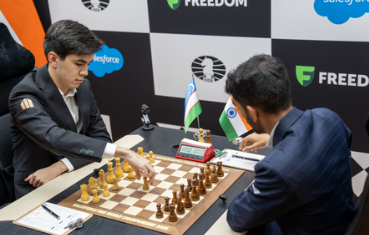
Geneva: Reigning world champion D Gukesh showed why the Berlin Defence remains such a formidable weapon, comfortably holding Uzbek challenger Javokhir Sindarov to a draw with the black pieces in Game 3 of the World Chess Championship here on Thursday.
The players are now tied at 1.5 points apiece heading into Friday’s rest day.


Gukesh looked well prepared for the opening and handled Sindarov’s attempts to gain an advantage with confidence. Even when computer evaluations suggested that white had the upper hand, the Indian appeared to know exactly where to find the right moves and how to keep his position intact. The draw also leaves him with the white pieces in the next game.
“Berlin is in Geneva” is a phrase that has endured in chess circles since Vladimir Kramnik famously employed the same opening to beat Garry Kasparov in their much-anticipated world championship match in 2000.
It was not easy for Sindarov in the third game as he faced a rather brutal variation of the opening. The Uzbek was caught by surprise and ended up spending a lot of time navigating the opening. At one point, he even fell short of time, a situation typically associated with Gukesh when he is playing black.
Gukesh looked completely at ease for much of the game, giving nothing away in the opening and comfortably meeting Sindarov’s attempts to seize the initiative. Both players continued to probe for an opening, but neither could make a decisive breakthrough. With a draw by mutual agreement permitted only after 40 moves, they had to play out the mandatory moves before the incremental time kicked in.
The battle retained some tension even after the game moved into the incremental time phase.
Sindarov made his intentions clear with an aggressive kingside pawn move that could well have changed the course of the game. Gukesh, firmly in command, paid little attention to it, signalling that he was happy to accept the likely outcome.
Gukesh was the human engine for once, finding the best moves as Sindarov tried to eke out a slight advantage. The back-and-forth king manoeuvres were among the easier aspects of the game for spectators to follow.
Sindarov tried to turn up the heat in the rook-and-opposite-coloured-bishops endgame. Gukesh, meanwhile, enjoyed an advantage on the clock, but the result was never in doubt. With a draw appearing inevitable, the Indian ace continued to play out his moves before the players eventually agreed to peace after 60 moves.
With 11 games still remaining in the 14-game match, it appears Gukesh has a few surprises up his sleeve in terms of preparation, while Sindarov has some questions to answer about his own match preparation.
As per the rules, the first player to reach 7.5 points will win the title. In case of a 7-7 tie after 14 games, shorter-format games will be played to determine the winner.
The time control is 120 minutes for the first 40 moves, followed by an additional 30 minutes from move 41, along with a 30-second increment per move. Quick draws by mutual agreement are not allowed before 40 moves. However, a draw can occur through threefold repetition or stalemate.
The total prize fund for the match is USD 2.5 million. Each win is worth USD 200,000, while the remaining amount will be split evenly. If the match goes into shorter-format tiebreaks, the winner will take home USD 1.3 million, while USD 1.2 million is reserved for the runner-up.