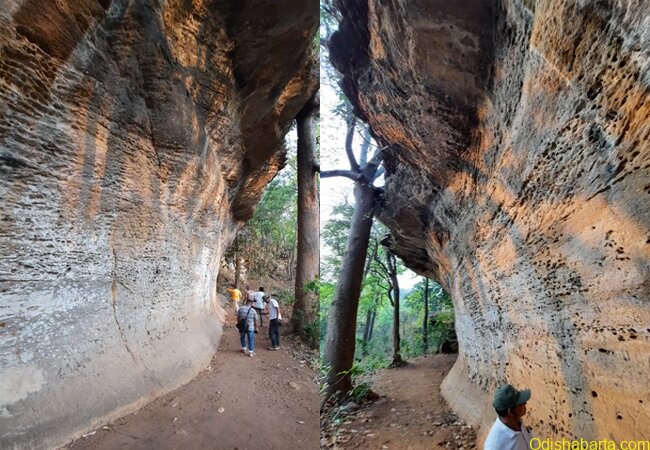
Bhubaneswar: Odisha’s ancient Bhima Mandali caves, believed to preserve some of the state’s oldest traces of prehistoric human civilisation, urgently need scientific conservation and protection by the Archaeological Survey of India (ASI), rather than tourism-driven development, heritage experts have warned.
Expressing concern over the Odisha government’s recent announcement to develop Bhima Mandali as an eco-heritage tourism site at Redhakhol, Anil Dhir, heritage expert and Convenor of the INTACH Bhubaneswar Chapter, said that the priority should be safeguarding the fragile archaeological treasures of the region. He cautioned that developing the site as a tourism destination without adequate conservation measures could expose its priceless heritage to further deterioration. Located deep inside the Naktideul Forest Range near Redhakhol, the Bhima Manda li caves and rock shelters are renowned for their prehistoric rock art, stone inscriptions and archaeological remains.


Hidden beneath dense forest cover, the caves contain paintings and engravings believed to date back approximately 15,000 years. Local traditions also associate the site with the Pandavas of the Mahabharata. Dhir pointed out that although Bhima Mandali has not yet been formally declared a protected archaeological site by the ASI, the organisation has undertaken archaeological surveys and excavations in the region, documenting prehistoric rock art, stone tools and evidence of ancient human habitation. He recalled that in 2023, the ASI had indicated that neglected rock art sites across Odisha would receive priority consideration for protected-site status. Odisha, he said, has nearly 140 caves containing rock art, but only one site – Vikramkhol, situated in the reserve forest of the Belpahar Range in Jharsuguda district – enjoys ASI protection.
Even there, approximately 80 per cent of the rock art has reportedly suffered damage. The famous rock art at Sitabhinji in Kendujhar district has also faded considerably and is now largely indecipherable. He stressed that bringing the entire Bhima Mandali complex under the protection of the ASI has become an urgent necessity. Over the years, several rock engravings and paintings have suffered erosion and damage due to rising temperatures, the removal of forest canopy and vegetation, vandalism, graffiti and fires lit by visitors and picnickers.
Meanwhile, Surya Sarathi Roy, Director (Operations) of the Indian History Awareness and Research (IHAR), emphasised that rock art represents one of humanity’s earliest forms of artistic expression and constitutes an invaluable part of the world’s cultural heritage. He said protecting these ancient paintings and engravings requires a comprehensive conservation strategy combining physical protection, scientific documentation, visitor management and active participation of local communities. Unregulated tourism, vandalism, graffiti and even the seemingly harmless practice of touching ancient paintings can cause irreversible damage, he cautioned. Roy suggested that the ASI should introduce a series of scientific conservation measures at Bhima Mandali, including perimeter fencing, elevated walkways and viewing barriers to maintain a safe distance between visitors and the rock art panels. Drip lines could also be installed to divert rainwater away from painted surfaces and prevent further deterioration.