
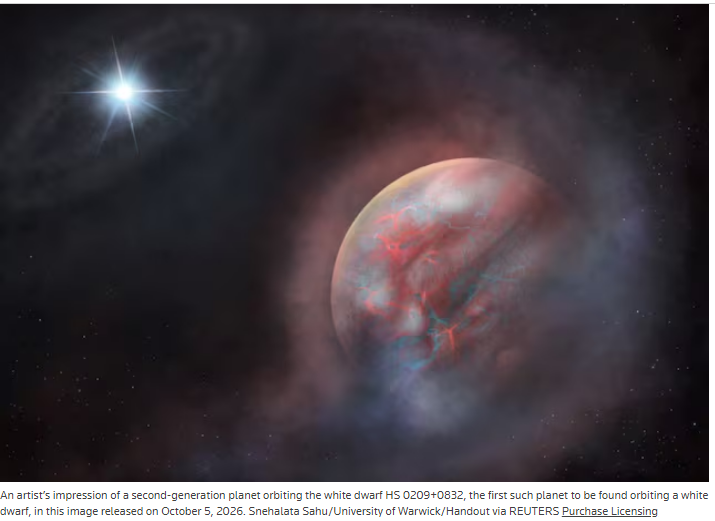
Washington: In ancient mythology, the phoenix was a miraculous bird with a cyclical pattern of life and death, perishing in flames only to rise again from the ashes.
Astronomers have now found a world that rightly can be called a phoenix planet.
Researchers said this exoplanet, as planets beyond our solar system are called, appears to have been born from material expelled into space during the death throes of a star a bit bigger than the sun, and now orbits the highly compact stellar remnant that was left behind, called a white dwarf.
It is classified as a second-generation planet, meaning it did not form from the swirling disk of material surrounding a newborn star, as Earth and other first-generation planets did, but rather from the leftovers of a doomed star.
“This is the first example of a planet forming around a white dwarf,” said Jamie Williams, a doctoral student in astrophysics at the University of Warwick in England and lead author of the study published this week in the journal Nature Astronomy.
The white dwarf is located about 250 light-years from Earth, near the constellation Cetus.
A light-year is the distance light travels in a year, 5.9 trillion miles (9.5 trillion km). The planet is a gas giant, perhaps slightly more massive than Jupiter.
It orbits the white dwarf every 4.4 days at only 4% the distance between Earth and the Sun.
It is so close that the blazing ly hot white dwarf’s extreme ultraviolet radiation is causing the planet’s outer atmosphere to evaporate, with a portion then falling into the white dwarf.
The planet’s chemical pattern points to its second-generation origin.
It is rich in niobium, copper and zinc, the type of elements that certain dying stars cast off when they expand in their death throes, indicating the planet formed from a disk of this expelled material that surrounded the stellar corpse.
“In myths, a phoenix is born again from its own ashes. In the case of this planet, it is born again from the ashes of its dying host star, and therefore the planetary system is reborn.
A second-generation planet is defi ned as one born after its host star dies — in this case after it has become a white dwarf,” Williams said.
The researchers used data from the orbiting Hubble, TESS and FUSE telescopes, and hope to use the James Webb Space Telescope to confirm their conclusions.