
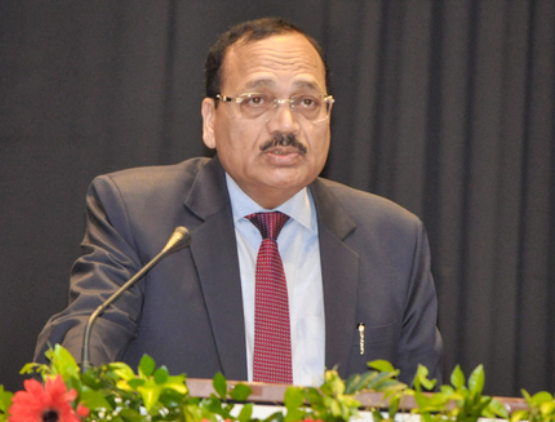
New Delhi: Emphasising the need to make the Supreme Court a “people’s court”, Chief Justice of India Surya Kant Thursday said access to it should not be governed by the stature of a person or as a matter of privilege.
Speaking at a Constitution Day function organised by the Supreme Court of India and attended by President Droupadi Murmu, the CJI said, “We must ask ourselves whether justice, as dispensed here, has reached everyone it was meant for, or it has, at times, remained the privilege of those who already knew the way to our doors.”
He said it would not be honest of him to pretend that the answer has always been a comfortable one.
The CJI said there was a time when this court was seen, and not entirely without reason, as a court of the privileged, more readily available to a familiar few than to the many and in those days, an out-of-turn hearing could sometimes seem to depend on who rose to ask for it, rather than on how urgently it was needed.
“For those of ample means, the highest court in the land was at times less a court of last resort than one of first resort, approached at the earliest stages of a dispute. By contrast, for the vast majority of our people, many of them in the greatest need of justice, this court was revered from afar, but seldom reached,” he recalled.
CJI Kant said that despite all this, in those years, the court had begun to change, for more than four decades ago it started treating letters, and even postcards, as petitions espousing the public causes.
“A single letter written on behalf of bonded labourers in the stone quarries of Faridabad was once enough to secure their freedom. Though this public interest jurisdiction has, at times, been abused and misused, it taught this institution that its strength lies as much in the doors it keeps open as in the questions it decides,” he said.
The CJI added that a door held open, however, counts for little if a privileged handful may still stride through it ahead of everyone else, and on this, he sees no virtue in delicacy.
“That era is now over, for even the most eminent among them must appear on the same footing as a lawyer from a small town, bound by the same queue, the same clock and the same rules,” he added.
The CJI emphasised that many judges have laboured long to bring about the levelling which was required and to make this court in the fullest sense the “people’s court”.
He added, “When access to a court is governed by system rather than by stature, privilege finds little room within it, and it is in this quiet, everyday work, far more than in any proclamation, that a people’s court is truly sustained.”
The CJI said keeping this court open to all is never a finished undertaking, and in recent years, the institution has been steadily dismantling the barriers that once stood in the citizen’s way.
“To begin with, fresh matters are now listed automatically, without anyone having to rise in court and plead for a date, while cases touching personal liberty or urgent interim relief must reach a Bench within two working days,” he said while underscoring the steps taken.
CJI Kant said the court has carefully identified those who can least afford to wait, whether they are persons with disabilities or survivors of acid attacks, senior citizens above the age of eighty, families below the poverty line or litigants who come through legal aid.
“Their cases are given priority in listing, for when the very act of coming to court is an ordeal, the least we can do is ensure that their turn comes in good time. Because every such priority rests on criteria announced in advance and applied alike to all, the listing of cases follows a transparent and uniform pattern, in which no one is shown undue favour,” he said.
The CJI added that technology has carried this effort well beyond these precincts, for hearings by video conference allow an advocate in Kohima or in Kutch to argue before this court without leaving their own town.
He highlighted steps like video conferencing, live streaming of Constitution Bench hearings and use of artificial intelligence (AI) translation software for carrying judgments into the languages of the people.
“This year has also seen the launch of the One Case, One Data initiative, which traces the record of a case all the way from the taluka court to the Supreme Court, along with an AI-powered assistant that guides litigants through our procedures,” he said.
The CJI emphasised that access to justice begins long before a case reaches any Bench, from the very moment when someone in need first looks for help and said, “We are on a continuous mission to ensure that no citizen ever finds the doors of justice closed.”
He said, “Even as we celebrate this day, I am conscious that much remains to be done before the humblest litigant can feel at ease in this court as much as its most celebrated advocate. Yet I take heart in the knowledge that while all who hold office here do so only for a season, the court itself belongs to every season yet to come, and to every citizen who will one day stand before it.”
Justice Vikram Nath welcomed the guests and said that for those in the judiciary, the responsibility is to ensure that the Constitution remains a source of strength and protection for every citizen.
Attorney General R Venkataramani, Bar Council of India Chairman Manan Kumar Mishra and Supreme Court Bar Association (SCBA) President Pradeep Kumar Rai also spoke on the occasion.