
ARINDAM GANGULY, OP
Bhubaneswar: As many as 39.55 lakh e-challans involving Rs 1,136.62 crore were pending with regional transport offices (RTOs), courts or police authorities, while enforcement officials failed to impose fines amounting to Rs 640.87 crore for multiple motor vehicle offences, according to a Comptroller and Auditor General (CAG) of India report.
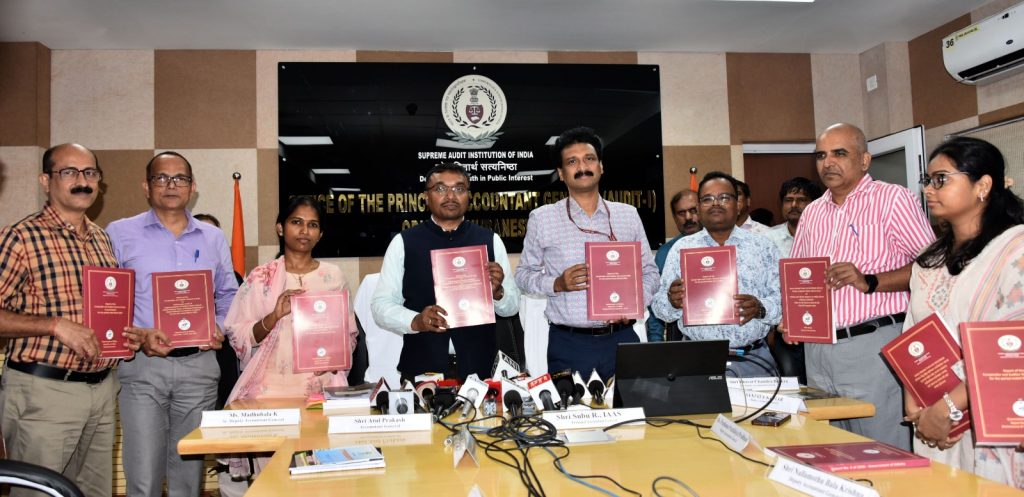
The findings are part of the CAG’s Subject Specific Compliance Audit Report on the “Functioning of State Transport Authority and Regional Transport Offices in Odisha”, covering the period from 2019- 20 to 2023-24. The audit highlighted deficiencies in traffic enforcement, tax collection, vehicle safety compliance and permit management, raising concerns about the effectiveness of the state’s transport regulatory system.
The CAG found that 39.55 lakh e-challans involving Rs 1,136.62 crore were pending with RTOs, courts or police authorities. As a result, vehicles continued to ply without payment of applicable taxes and penalties. The audit also found that enforcement officials often booked only one or two offences even when motorists had committed multiple violations.
“The failure to record all applicable offences resulted in the non-imposition of fines amounting to Rs 640.87 crore,” it said. The findings point to significant gaps in the enforcement of motor vehicle laws and the collection of penalties from traffic violators. The CAG also criticised the department’s approach to recovering outstanding motor vehicle taxes. Against a target of Rs 530 crore, the department had collected only Rs 9.71 crore, or 1.83%, in arrears as of August 2024.
The audit also identified instances of short levy and non-levy of taxes on stage carriage permits. In 75 cases, taxes amounting to Rs 30.23 lakh were either not levied or were collected at amounts lower than applicable. A maximum penalty of Rs 60.45 lakh was also leviable on the unpaid tax. In another 30 cases, ordinary permits were issued instead of express permits for stage carriages, resulting in a loss of tax and additional tax amounting to Rs 14.59 lakh.
The audit pointed to the absence of an effective regulatory mechanism for aggregator services and the failure to prescribe a base fare. This allowed aggregators to operate without licences and determine fares at their discretion, according to the report. It also found inconsistencies in the levy and collection of one-time tax on the sale of vehicles due to the absence of a fixed base price for calculating the tax. The CAG found that the department accepted motor vehicle tax without ensuring that vehicles had valid fitness certificates (FCs) recorded in the VAHAN system, in violation of the Motor Vehicles Act.
Consequently, inspection fees amounting to Rs 73.18 lakh from 9,760 vehicles could not be realised. The report also flagged the registration of public service vehicles without ensuring the mandatory installation of vehicle location-tracking devices and emergency buttons. The omission, the audit said, compromised the safety and security of women passengers. Further, the department failed to ensure the installation of high-security registration plates (HSRPs) on 17.61 lakh vehicles registered before March 2019. Another 1.52 lakh vehicles were registered without HSRPs during the period through March 31, 2024.