
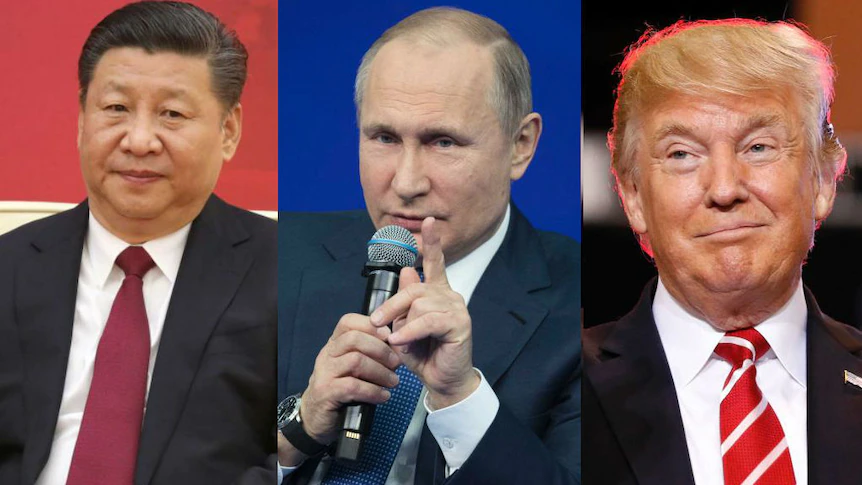
A rough sketch of a spheres-of-influence world order is becoming more and more visible as US President Donald Trump takes the lead in this direction with seemingly tacit approval of his counterparts in Russia and China – Vladimir Putin and XI Jinping. This is amply clear now from the statements of Trump who has suggested the future of Taiwan is “up to” Xi while seeking to distinguish the issue from Washington’s attack on Venezuela. This strategy is almost a carbon copy of what he is doing in the ongoing Russia-Ukraine war virtually leaving “up to” Putin how he would keep in Russia’s possession the Ukrainian territories he has already overrun. To hoodwink the world he said he would be “very unhappy” if Xi moved to seize control of the self-governed island through military action. That he would not mind if China takes such a course of action is evident from the fact that he hoped Xi would desist from such an adventure during his presidency and he believes Xi “may do it after we have a different President.” Trump’s tenure ends in early 2029. On the other hand, the possibility of the US of A trying to take control of Greenland is looming large by the day. Greenland is a self-governed island in the north Atlantic belonging to Denmark, a NATO member.
Meanwhile, the UK’s move to mobilise NATO forces in defence is a serious development, though the preparation is being glossed over as a step to stop Russia and China from attacking the country. Frank Rose, a former US Assistant Secretary of State (under the Obama administration) and the last American official to negotiate a defence deal with Denmark and the Greenland Home Rule administration, warned in a recent response to the media that Trump’s aggressive threats and alarming move toward acquiring Greenland could prove counterproductive. Rose, who negotiated a key agreement in 2003-2004 for satellite defence systems on Greenland, agreed the island was “critical” to US defence. Trump’s posturing, he said, is needless from this standpoint since the US already has significant rights under existing treaties. He may end up antagonizing Denmark and Greenland, which would then become less cooperative with the US in future engagements. Trump has repeatedly expressed interest in controlling Greenland, citing national security needs to counter Russia and China in the Arctic. That appears to be a ruse. China and Russia have been seeking regional spheres of influence for years.
Under Trump, it is increasingly becoming possible that the US would be a willing partner in this game of apportioning different regions for their respective gains of new territories and priceless natural resources. Trump’s recent moves to get closer to Putin and Xi are well-suited to spheres-of-influence diplomacy. He does not seem averse to striking great-power bargains at the expense of weaker states.
Also Read: Self-Sabotage
Spheres of influence are an arrangement in which a strong country governs the destiny of a weaker one. Such a global scheme may take the form of outright conquest of territory or loose arrangements that still provide influence over a country’s policies and politics. The US appears to be eager to regain sway over Latin America. It has already tied Latin American economies to its own, meddled pervasively in their politics and conducted dozens of military interventions against actual or potential threats. Putin’s war in Ukraine is the apogee of a 25-year project to revive Moscow’s primacy in what Russians call its “near abroad.” Xi is pursuing “Asia for Asians,” code for a region in which Beijing rules because Washington is no longer interested in spending billions of dollars to control faraway regions. When viewed under this light, India could be termed a weak nation and considered as falling under the Chinese sphere-of-influence. The adventure of the Trump-Putin-Xi troika is fraught with deadly consequences for the rest of the world. A divide-the-world approach might deliver temporary stability with the big powers forcing the weaker states to surrender to their bullying, but in the long run, maybe very long, yet spheres of influence cannot be the path to peace but the road to disquiet and disaffection