
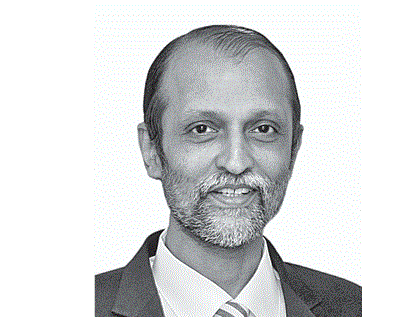
Ajit Ranade
The just-concluded BRICS summit in Delhi may not be remembered for a particularly muscular declaration. But that may miss its more important consequence for India. Did BRICS help accelerate the thaw in India-China relations? India’s diplomatic achievement was not that it convened the summit, since it was anyway the BRICS chair. It was that it managed to hammer out a common declaration among countries whose interests frequently collide. Iran and the UAE could sit around the same table despite their tensions; China could sign language condemning the Pahalgam terrorist attack; and members could agree on a dialogue in West Asia despite sharply different alignments. There is a lesson here closer home. If India can manage contradictions within BRICS, why can it not manage the contradictions in its own multi-compartment relationship with China?
The Modi-Xi meeting on the summit sidelines was more important than thecommuni que. Xi was visiting India for the first time in seven years. The two leaders discussed border peace, business links, market access, the structural trade imbalance and greater exchanges. It would be foolish to call this reconciliation. But it is certainly an opportunity. India and China are neighbours, accounting together for more than one-third of humanity. Geography cannot be wished away. Nor will their border dispute disappear soon. Deng Xiaoping’s famous advice to Rajiv Gandhi in 1988 remains relevant: if our generation lacks the wisdom to solve the boundary question, let us leave it to a wiser future generation. That does not mean forgetting Galwan, where 20 Indian soldiers died in 2020. The border must remain strongly defended. But the border can stay cold without freezing the entire relationship.
Indeed, India and China are already practising compartmentalisation. At the SCO summit in Bishkek, they joined Paki stan, Russia and others in a declaration rejecting double standards in combating terrorism. If such contradictions can be managed inside SCO and BRICS, they can also be managed bilaterally. The compartments are obvious: border security; trade and investment; technology; rivers and riparian rights; Himalayan ecology; climate change; WTO reform; nuclear non-proliferation; universities, tourism and culture; and even selective cooperation on international conflicts. The economic case for such realism is overwhelming. India’s trade deficit with China is around $112 billion. Yet our dependence is not principally on cheap toys. China supplies vital APIs, electronic components, machinery, solar inputs and processed critical minerals. After Galwan, India tightened Chinese investment and technology access.
Yet imports kept rising. The attempt to reduce political exposure did not eliminate economic dependence. Our withdrawal from RCEP in 2019 offers a warning. India spent nine years negotiating the agreement but walked out abruptly in 2019, ostensibly because of fear of Chinese imports. Those imports came anyway. We could have backloaded by 15 years, the conditionalities allowed in RCEP. What India may have sacrificed was the more valuable prize: becoming embedded in Asian production networks. Modern trade is not merely about bilateral deficits. It is about where supply chains, factories and future investment locate. India’s approach to China is not as a supplicant. China has formidable economic strength, but also serious vulnerabilities. Its population is ageing, its workforce is beginning to shrink, its property sector is struggling, debt is high, domestic consumption remains weak and excess industrial capacity increasingly needs external markets.
The IMF expects slower medium-term growth as demographics, weaker productivity and declining returns on investment bite. China therefore needs India too. India offers one of the world’s largest and fastest-growing markets, a younger labour force and an alternative destination for Chinese capital facing increasing barriers elsewhere.
The appropriate response is not “keep China out,” but: if you want access to the Indian market, manufacture here, employ here, source increasingly here and export from here. Why not begin by reopening serious discussions with BYD about an Indian factory? BYD is now one of the world’s dominant EV manufacturers. Its Indian ambitions were caught in the post-Galwan investment freeze. Invite it back to the table—but on Indian terms: local manufacturing, Indian employment, supplier development, strict data safeguards and progressively higher domestic value addition.
Press Note 3 should evolve from blanket suspicion toward risk-based screening. Chinese participation in telecom networks is obviously different from passive Chinese capital financing a highway, warehouse, water project or irrigation system. This is “quarantined engagement,” a pragmatic policy proposal outlined by Nitin Pai, Ajay Shah and this author last September: it says accept capital without management control, exclude sensitive Chinese technology and begin with “dumb infrastructure.” Then open some smaller doors quickly. Make visas for Chinese tourists, business visitors, academics and engineers easier. Restore more direct flights. Create a specially marketed Buddhist circuit—Bodh Gaya, Sarnath, Kushinagar and Nalanda—for Chinese tourists. Revive university partnerships in non-sensitive disciplines.
Encourage cinema, sport and cultural exchanges. Two civilisations representing such a large share of humanity should not interact mainly through soldiers, customs officials and diplomats. At the same time, India should insist much more forcefully on access to China’s vast consumer market. The answer to the trade deficit cannot merely be fewer Chinese imports. It must be more Indian pharmaceuticals, food products, services, entertainment and other goods entering China. China’s extraordinary growth, despite poor Ease of Doing Business rankings and the absence of Western-style democratic institutions, is a reminder that it must be understood as it is, not as theory says it ought to be. India should neither imitate China nor fear it. It should learn, compete and build its own capabilities—in aerospace, defence, semiconductors, critical minerals, pharmaceuticals and especially AI. Engagement is safest when backed by strength. AI sovereignty and technological capability are ultimately better insurance than import prohibitions. Nor should a China thaw dilute India’s ties with America, Europe, Japan or the Quad.
India should remain active simultaneously in BRICS, SCO, Quad, G20 and other useful formations. India’s future choices cannot be held hostage to any of these relationships. That is strategic autonomy. China assumes the BRICS presidency next year. The next twelve months of feran unusual window. A thaw does not require friendship, still less trust. It requires reciprocal interest and some imagination. Protect where we must. Compete where we should. Cooperate where we can. And use the time and space created by engagement to become stronger. BRICS may have broken some ice. India and China should now see whether they can turn that moment into a workable relationship.
The writer is a noted economist.
Orissa POST – Odisha’s No.1 English Daily