
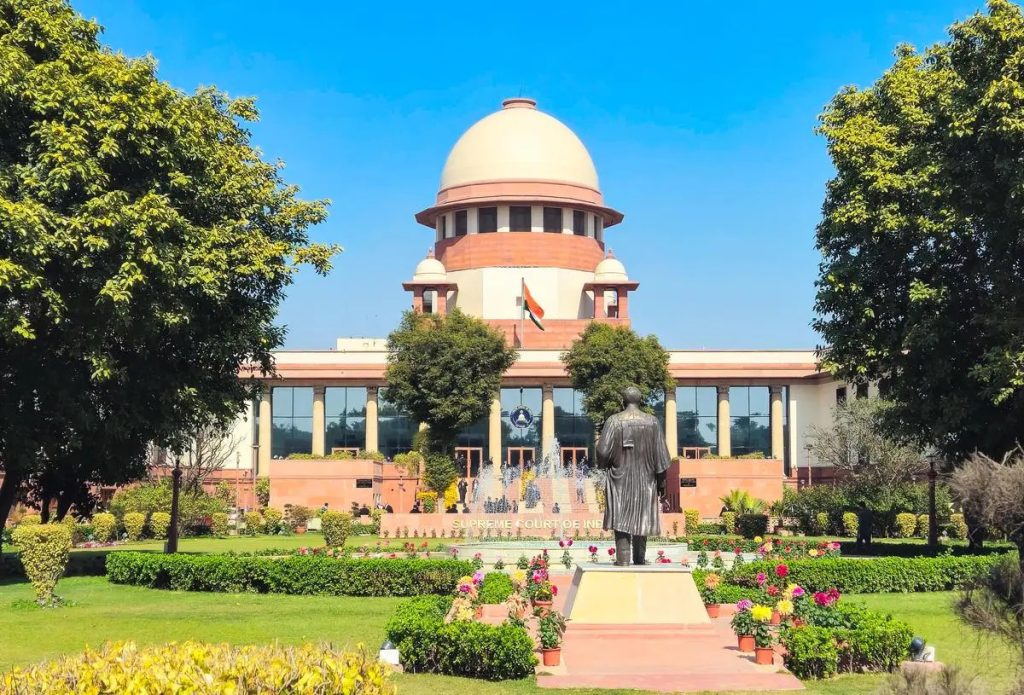
New Delhi: Amid a protest organised by the CJP in Delhi, the Supreme CourtSunday said people gathering peacefully should not be illegally detained and asked the Centre to ensure that the Delhi Metro functions normally and that there is no disruption to internet services, subject to law-and-order conditions.
In a special sitting, a bench of Justices Joymalya Bagchi and V Mohana also issued a notice to the Centre while hearing a plea seeking contempt proceedings for an alleged violation of the court’s direction to ensure that there is no complete prohibition on metro and train services in Delhi due to the Cockroach Janta Party (CJP) protest.
The protest call has been given by the CJP and some student organisations against Chief Election Commissioner (CEC) Gyanesh Kumar over alleged irregularities in the functioning of the Election Commission (EC).
The government thwarted a planned mass mobilisation at Jantar Mantar Saturday after an unprecedented security clampdown and the detention of more than 7,000 protesters, including CJP leader Abhijit Dipke, several opposition leaders and YouTuber Dhruv Rathee.
The bench asked Solicitor General Tushar Mehta to ensure that the Delhi Metro functions in accordance with its normal schedule, and that there is no disruption to internet services, subject to law-and-order conditions.
The court also asked Mehta to ensure that lawyers, journalists and others are not impeded in discharging their professional duties.
Internet facilities shall remain undisturbed, as per law…. When we are saying internet facilities shall remain undisturbed, we are not taking away the powers under the Information Technology Act.
There shall not be illegal detention, save and except by procedure established by law, particularly with regard to assemblage of people beyond the area within which it (section 163 of the BNSS) is imposed, the bench said.
It ordered that a board put up outside its premises stating that section 163 of the Bharatiya Nagarik Suraksha Sanhita (BNSS), which prohibits the assembly of five or more persons, shall be taken down.
We have been informed that a notice board stating imposition of section 163, BNSS, in and around the vicinity of the Supreme Court has been put up.
We direct the authority concerned to take down this board, if not already done, so that citizens as well as lawyers can have access to justice, the bench ordered.
During the proceedings, senior advocate Kapil Sibal, appearing in the court for Rashtriya Janata dal (RJD) MP Manoj Jha, told the court that police are detaining people from trains and anyone outside the four-km radius of Jantar Mantar, where prohibitory orders are in place.
He told the court that despite its October 9 order, 45 metro stations were closed for the entry and exit of passengers.
Senior advocate Menaka Guruswamy said around 45 detention centres have been opened in the city and around 7,000 people, including opposition leaders, were detained.
She contended that metro stations, namely the GTB Nagar and Vishwavidyalaya metro stations, besides other stations, were completely shut out to the public, and there has been a deliberate and willful violation of the court’s order.
Senior advocate Shadan Farasat, who was detained by the Delhi Police during the protests Saturday, submitted that he was brutalised along with a large number of lawyers and said the situation in the city was remarkably suppressive.
It is about the citizens’ right to protest. The sense I got yesterday was that we were one step away from a police state. Kindly restore the citizens’ right to protest peacefully in the capital. Yesterday, that right was destroyed, Farasat said.
Senior advocate Gopal Sankaranarayanan informed the court that senior advocates Dinesh Dwivedi, Uttara Babbar and Farasat were detained and individuals marching peacefully were subjected to violence.
Sankaranarayanan said free movement of individuals should be completely restored, all barricades removed and services at metro stations must be directed to be restored.
Mehta submitted that entry and exit were restricted at only 45 of the 303 stations October 10, accounting for only 15 per cent of the entire metro network.
He said the petitions that have sought the release of the detainees do not survive as most of those detained have already been released.
As the hearing commenced Sunday, the top court said it would grant a hearing to all lawyers while dealing with a plea seeking contempt proceedings against authorities for an alleged blatant violation of the court’s direction on the matter.
The court was also hearing a habeas petition filed by Guruswamy against the detention of political leaders.
The court is also seized of a plea by Jha alleging disproportionate use of force by the Delhi Police during the protests against the CEC and the EC.
The RJD MP has alleged that police indulged in illegal detention, abduction, house arrests of unarmed protestors, student leaders, lawyers, politicians and civilians, as well as sexual harassment of women protesters.
The contempt plea, filed by advocate Shailendra Mani Tripathi, has arrayed Union Home Secretary Govind Mohan, Delhi Police Commissioner Anurag Kumar and Delhi Metro Rail Corporation Chairperson D Thara as respondents.
The petition has referred to the top court’s October 9 order, which was passed while hearing a separate plea against the closure of 57 metro stations and cancellation of trains to Delhi in view of the protest.
While hearing the petition Friday, a bench of Chief Justice of India (CJI) Surya Kant and Justices Bagchi and Mohana directed the Centre to ensure that there was no complete prohibition of the movement of metro and trains coming to Delhi October 10 due to the protest, saying they cannot bring everything to a halt.
Though law-enforcement agencies have the right to take steps to restrict unruly movement, citizens should not be unduly harassed, the court had said.
The Delhi Metro closed 45 stations from 9 pm Friday till 6 pm Saturday for security reasons, according to an advisory.
In its October 9 order, the court said, It appears that the notifications are overreaching, as they impose a complete ban upon essential public transportation. Upon our indication that a distinction exists between total ‘prohibition’ and the ‘regulation’ of metro and other train movements, the solicitor general of India has fairly agreed to impress upon the authorities to reassess such prohibitions.
Regarding that assurance, we clarify that although there shall be no outright prohibition on the movement of metro trains, a prudent decision may be made to permit the operation of metro trains and other rail services in a suitable and regulated manner, the bench said.
It said such a decision should be widely publicised to prevent further inconvenience.
It said a traffic advisory should also be published in respect of smooth movement of vehicles in newspapers and on online platforms to ensure that no hardship or inconvenience is caused to the public in the course of travelling within the city.