
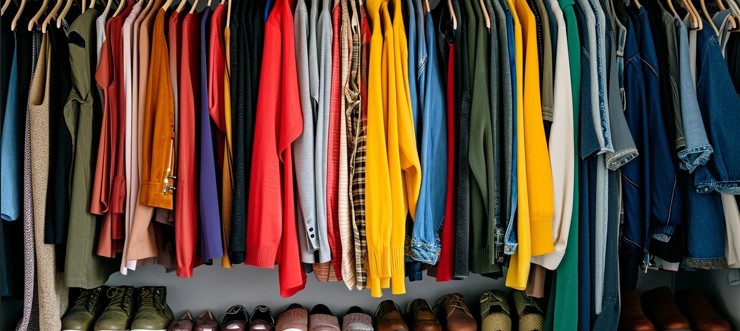
Jokes are aplenty about women taking forever to get ready and never having the right dress in their closet for any occasion. That’s despite the fact that their closet doors are practically waging a daily battle against gravity, struggling to stay shut under the sheer weight of the dresses inside it. Some may blame it on the female psyche, which strives for picture-perfect looks and assumes that every pair of eyes in the world steps outside solely to judge her fashion choices. But I believe the real villain here is fast fashion, which tempts you into endlessly buying clothes— whether you need them at that moment or not. You convince yourself that you’ll definitely need them soon and that this perfect piece was practically designed with you in mind.
But unfortunately, by the time the next occasion rolls around, you’re already convinced that the ‘pastel top’ you bought just a month ago no longer suits you. It’s not that the top has changed, nor have you—except, perhaps, for gaining a few extra grams— but now you’re convinced it only looked good under the magical trial room lighting or that the model on Myntra completely deceived you. So now, you have no choice but to buy another outfit—but it’s already too late for the current event. In a rush, you make yet another last-minute purchase that somehow works this time. But when the next occasion arrives, history repeats itself, and once again, you find yourself trapped in the same cycle of fashion-induced panic.
Once upon a time, people only bought clothes when they needed them. Now, we buy them because they’re 50% off and might be useful someday. That’s why your closet contains 12 pairs of jeans, yet you still wear the same two. Studies reveal that consumers now buy 60% more clothing than 20 years ago but keep them for only a fraction of that time. A typical fast fashion garment is worn just 7–10 times before being discarded. Fashion brands have mastered the art of convincing us that our perfectly fine clothes from last month are now unacceptable. “This season is all about millennial blue,” they whisper. “Your clothes are so last week,” they mock. And like obedient trend-chasers, you nod and fork over money for the latest must-have item—which will be must-forget item by next Tuesday.
And let’s be clear—fast fashion addiction isn’t reserved for the rich. I’ve seen my maid strutting around in outfits that could rival my own wardrobe, with more pieces than I can count. We can’t ignore social media’s role in all this chaos. Instagram reels, TikTok hauls, and endless Pinterest boards have turned fashion into a 24/7 global runway, making us feel like our perfectly fine wardrobe is suddenly outdated the moment we blink. Influencers flaunt the newest “must-have,” brands flood our feeds with limited-time drops, and before we know it, our closets are overflowing while our wallets cry. Social media hasn’t just sold us clothes—it’s sold us the illusion of eternal wardrobe inadequacy, all in the name of likes, shares, and FOMO.
In today’s world, when our own problems are far too many to leave little room for worrying about anyone else’s struggles, why is it that this wardrobe crisis of yours still manages to consume my thoughts? It’s because your problem has a bearing on our planet.
Forget about the people who aren’t too concerned about whether the next world war happens over water or not—unless, of course, their own bucket runs dry in the summer. But what about the ones who do understand the looming global water crisis? Do they realise how much their fashion choices are making it worse? Do we even stop to think that a single brand-new pair of jeans guzzled around 4000 18000 litre of water on average during the manufacturing process? That’s over 2000 cups of tea we could have had instead! Just imagine the genius (or absolute chaos) our caffeine-fueled brains could have unleashed with that kind of liquid motivation. But no—we sacrificed all that just to own another pair of denim that we’ll probably declare “out of style” in six months.
A significant portion – 60-90% – of fast fashion garments is produced using synthetic fabrics, which do not decompose easily. Instead, they gradually break down over decades or even centuries, continuously shedding harmful microplastics into the environment. These tiny plastic particles find their way into our water bodies, soil, and even the food chain, posing serious ecological and health risks. The industry produces over 92 million tons of textile waste annually, with up to 85% being landfilled or incinerated. While recycled clothing is often pitched as the big solution, but the reality is that the industry is still in its infancy and has yet to make a substantial impact. Currently, less than 1% of discarded textiles are successfully recycled into new clothing.
Textile dyeing and finishing are also responsible for over 20% of global water pollution, and the fashion industry guzzles a jaw-dropping 93 billion m³ of water each year—around 4% of all freshwater on Earth. Ironically, the countries churning out our cheap, trendy clothes—Bangladesh, China, Indonesia—are often desperately thirsty themselves. Then why do these countries still do it. Because making cheap, trendy clothes pays the bills, employs millions, and keeps the economy buzzing. That’s the irony of modern economy.
Gone are the days when an aerial view of our planet was a sight to behold. Today, satellites reveal images of a mountain of discarded clothes in the Atacama Desert of northern Chile, the Great Pacific Garbage Patch and our very own Ghazipur landfill. So the next time your closet doors threaten to burst open like a fashion-volcano, remember: those 12 pairs of jeans, 20 “must-have” tops, and that neon jacket you only wore once are not just cramping your style—they’re quietly waging war on water, polluting rivers, and shedding microplastics like confetti at a parade you didn’t RSVP to. Fast fashion may keep your wardrobe Instagram-ready, but Mother Earth is definitely not liking your posts. Maybe it’s time to stop chasing “this season’s must have” and start giving your old clothes—and our planet—a little TLC. After all, your closet’s drama is hilarious but the planet might not be laughing.
The writer is an Additional Director and researcher at the Parliament of India.