
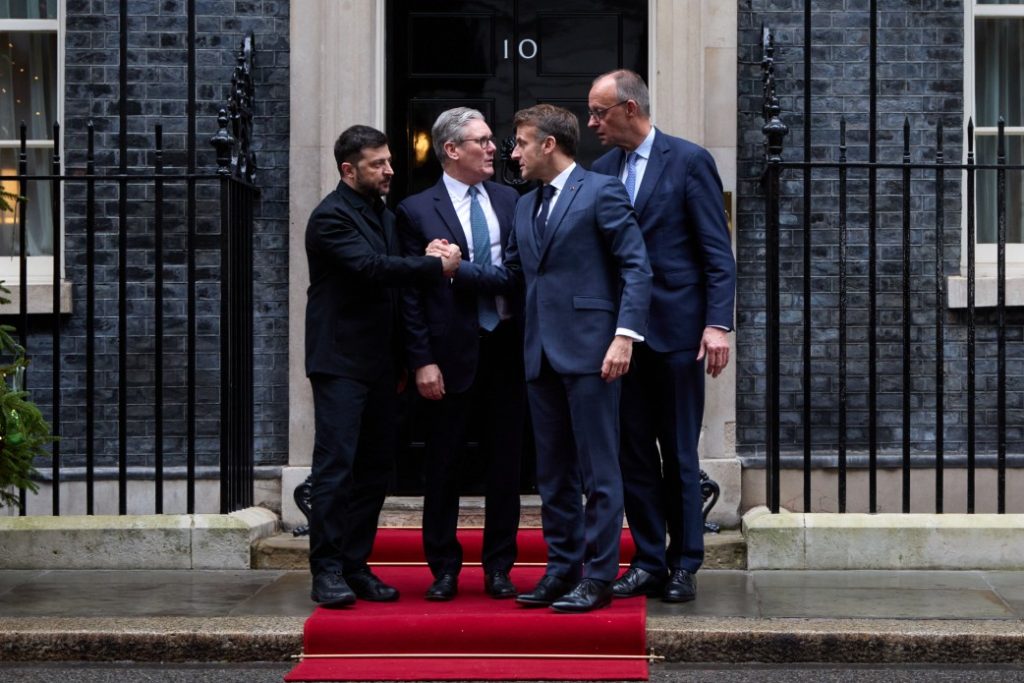
At a crucial juncture when US President Donald Trump seems to be too eager to make Ukraine a sacrificial lamb to the aggrandisement of Russian President Vladimir Putin, three European countries – the UK, France and Germany – made a reassuring gesture by organising a summit of sorts in London December 8 to throw their weight behind Ukraine’s President Volodymyr Zelenskyy. UK Prime Minister Sir Keir Starmer, French President Emmanuel Macron and German Chancellor Friedrich Merz held talks with Zelenskyy.
The meeting came in the wake of US efforts to get Kyiv and Moscow to sign up quickly to a plan to end the war in Ukraine. Kyiv is in an existential crisis as the US brokered plan wants it to cede territory to Russia. While Ukraine doggedly opposes the idea of forking out its own territory, it also wants security guarantees to ensure that Moscow respects an eventual agreement. Starmer lent his voice to the second proposition when he said Ukraine needed “hard-edged security guarantees”. He has also repeatedly said that Kyiv must determine its own future and not have conditions imposed on it. This is only natural if we understand the current situation that the three European countries are concerned not only for Ukraine’s future, but also for the security of the continent as a whole. Their anxiety stems from the fact that if Russia is “rewarded” with Ukrainian territory as part of a peace deal, it could then attack other European countries in the future with similar demands.
The question is whether the three European countries will eventually be able to stand up to Trump’s pressure tactic. The visuals of Europe’s arguably most influential nations standing shoulder-to-shoulder with Zelenskyy in Downing Street tell only one part of the story. The other part will unfold when they come to Washington. For the US has made its intentions clear in its National Security Strategy published on December 5 by slamming Europeans for having “unrealistic expectations” as to how the Ukraine-Russia war might end. The three European countries fear, as experts point out, that Trump is interested only in thrashing out a quick fix formula for peace in Ukraine, whereas that could only be a temporary truce which will give fillip to even more Russian intrusions into Europe. Recent incidents show ominous signs pointing towards that direction. For example, unmanned drones caused chaos in civilian airports in Germany, Denmark, Belgium and elsewhere, while an act of railway sabotage was reported in Poland that could have cost lives. There have also been significant cyberattacks across the continent. Russia is suspected of being the author of such acts. War in Ukraine seems to be just the tip of the iceberg for Europe. This has strengthened the fears that Russia would like to weaken their continent as a whole.
Also Read: President Groped
However, till now, such European concerns have not expressed loudly, and Europe is walking a tightrope while dealing with Trump. Zelenskyy, too, is circumspect. He needs both the US and European powers for the survival of his fellow countrymen. He can ill afford to antagonise the unpredictable and bullying US President, whereas the three European countries alone may not be able to provide him a sense of security to ward off Russia. European countries can do nothing independent of the Trump-led US. This is evident from the words of Starmer, who praised the US President for his peace negotiations. In a compliment to Trump, he said this is “the furthest we’ve got in the four years” in just a few weeks. German Chancellor Merz, however, expressed scepticism about the peace deal and said it needs to be carefully examined. In short, European leaders are in no position to incur Trump’s wrath even after his flip-flops over the US stand on Putin’s treatment of Ukraine.
Obviously, the US is the biggest and most powerful member of Nato. Europe relies on Washington for intelligence, military command and air force capabilities. The difference in the perception of Russia between Trump and European leaders is making the peace process in Ukraine torturous. Trump holds the key. He does not have a high opinion of European powers, even though he cannot turn his trusted allies into enemies. The question is how long he will listen to them. Putin too may be counting on this for his own domestic survival.