
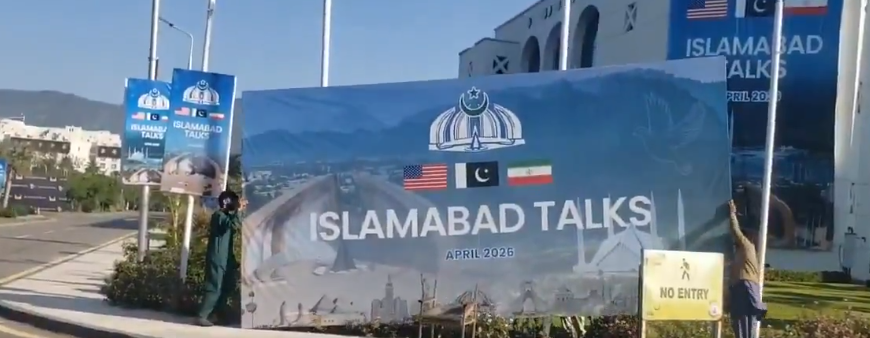
The collapse of the Iran–US peace talks in Islamabad marks yet another sobering moment in a conflict that has already destabilised West Asia and sent ripples through much of the global economy. Despite marathon negotiations lasting over 20 hours during the high-level direct engagement, both Washington and Tehran walked away without an agreement and blamed each other for the impasse.
The US delegation, led by Vice President JD Vance, reiterated its demand that Iran must forgo any pathway to acquiring nuclear weapons. For America, this has been a non-negotiable term as it concerns the country’s broader geopolitical posture. At the same time, Vance’s assertion that the failure of the talks will be “worse for Iran” reflects a mindset that still believes in American military and economic might, despite the sobering lessons from Iran’s response to US-Israel strikes over the past month and more.
Tehran, on the other hand, views the matter through a radically different lens. Led by its parliamentary speaker Mohammad Bagher Ghalibaf, the Iranian delegation framed the breakdown of talks as a consequence of “excessive demands” and a persistent lack of trust. “Before the negotiations, I emphasised that we have the necessary good faith and will, but due to the experiences of the two previous wars, we have no trust in the opposing side,” Ghalibaf said in a series of posts on the social media platform ‘X’. For Iran, the trust deficit is rooted in decades of hostility marked by economic sanctions, military confrontations, and broken agreements with America. Iran’s resolve to retain its nuclear programme, while denying any intent to build weapons, signals its unwavering stand on what it considers its sovereign right.
The Islamabad talks, mediated by Pakistan, were significant not only for their content but also for their context. They followed a 2-week ceasefire that had briefly raised hopes of de-escalation after weeks of conflict triggered by US and Israeli airstrikes on Iran. Yet, even as diplomats negotiated, the region remained volatile with Israeli operations against Hezbollah in Lebanon continuing full force.
What stands out sharply in this diplomatic episode is the central role played by Pakistan’s leadership. Islamabad emerged as a crucial interlocutor, hosting and facilitating a high-level engagement between Washington and Tehran. Under the stewardship of Foreign Minister Ishaq Dar and backed by its military establishment, Pakistan positioned itself as a credible mediator capable of engaging both sides. This is a notable geopolitical moment for a country often seen as a failed state. Pakistan’s role as mediator deserves recognition, even if the immediate outcome fell short. Similar to the International Monetary Fund (IMF) announcing a large basket of funds for Pakistan while a kind of mock war with India (labelled Operation Sindoor by India) was in progress, Pakistan has again been bestowed with another huge largesse of the Saudis and Qataris who have committed US$5 billion for the yeoman service rendered for peace-making efforts in the Middle East.
India’s absence from this diplomatic high table is unfortunate. Its historical ties with Iran got severed recently by the sudden desertion from Chabahar, and the strategic partnership with the US came to nought while ‘friend’ President Trump constantly threatened India with high tariffs. Likewise, in the case of India’s superficially deep stakes in West Asia, especially in energy security and the welfare of its diaspora, New Delhi found itself on the margins. This diplomatic sidelining of India raises uncomfortable questions about the effectiveness and agility of its foreign policy in a fast-shifting geopolitical landscape. The directionless diplomacy pursued by New Delhi over the last decade has made enemies out of the country’s neighbours, while major world powers like the US, China and the European Union see India not as a geopolitical power, but as a vast market for their companies.
In spite of India’s leadership constantly talking against Pakistan, trying to discuss ‘terrorism’ on every international forum and making efforts to tag that country as a ‘failed’ and ‘terrorist state’, these talks held in Islamabad have proven that Pakistan’s consistent diplomatic endeavours have succeeded while India has, sadly because of a few incompetent individuals, failed miserably on the global platform. Of course, all these failures may get washed away from the minds of Indians after the impending election results are declared, but the world is not waiting for Tamil Nadu, West Bengal or Kerala Assembly outcomes.
While Pakistan seized the opportunity emerging out of the tensions in West Asia to act as a bridge, India appeared incapable of asserting a mediating role, thereby ceding diplomatic space to its archrival.
Meanwhile, the consequences of the failure of the peace talks are likely to be borne by the whole world. The Strait of Hormuz, a critical artery through which nearly a fifth of global oil supplies flow, was completely safe and open till 28 February 2026, till the attack by the US-Israel on Iran commenced, has now become a moot point for ending the war. Iran’s demands for control over the Strait and the imposition of transit fees are seen by the West as untenable, while Tehran views them as leverage in a conflict where it faces overwhelming economic pressure. After the failure of the talks with Iran, Trump has said that the US will blockade the Strait of Hormuz. For India, one of the world’s largest energy importers, prolonged instability in this corridor has immense direct economic ramifications.
The Islamabad talks may have ended without an agreement, but they have also exposed shifting diplomatic equations, where new actors have emerged, while a few others, like India, have been consigned to the sidelines.