
Amaravati/Bhubaneswar: The process of a very severe cyclonic storm ‘Arnab’ crossing the Andhra Pradesh coast continued Wednesday morning, and is likely to completely cross the shore by afternoon, the State Disaster Management Authority said.
Under its influence, heavy rainfall and strong winds continue in coastal Andhra Pradesh, Yanam, and parts of southern Odisha, the IMD said.
Odisha government has evacuated over 30,000 people to safety, with the entire southern region of the state remaining on high alert Wednesday after the landfall process of very severe cyclonic storm Arnab was completed along the Andhra Pradesh-Yanam coast, a minister said.
Disaster Management Minister Suresh Pujari said the state expects the cyclone to affect all southern districts, with Malkangiri likely to be the worst hit.
“The cyclone is presently within Andhra Pradesh, and it will later in the afternoon touch Odisha,” Pujari said, adding that personnel and equipment had been mobilised at vulnerable locations and evacuation was continuing.
The government’s focus is on Ganjam, Gajapati, Rayagada, Koraput, Malkangiri and Nabarangpur districts, where people from low-lying and landslide-prone areas are being shifted to shelters, he said.
Schools and anganwadi in 16 of the state’s 30 districts remained closed for the day.
The cyclone, which started making landfall in the early hours of the day, is currently centred about 30 km from Narsapuram.
Heavy rains accompanied by gusty winds continued in the undivided Srikakulam, Visakhapatnam, East Godavari, West Godavari and Krishna districts.
Andhra Pradesh State Disaster Management Authority (APSDMA) Managing Director Prakhar Jain said people should remain alert.
According to him, the process of steadily crossing the shore has been ongoing for two hours.
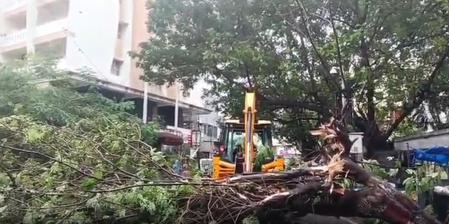
There are no reports of any loss of life so far. However, trees and electric poles were uprooted, and crop damage was reported from affected areas. Preliminary reports suggest that the Godavari districts were the worst affected by the cyclone. Low-lying areas in Dr BR Ambedkar Konaseema district were inundated. The tree falling disrupted the electricity supply in some areas.
Meanwhile, Chief Minister N. Chandrababu Naidu held a teleconference on the impact of the cyclone and relief operations
The teleconference involved 32,000 personnel, ranging from District Collectors to field-level staff
The Chief Minister also held a special review meeting with senior officials from the departments of Electricity, Irrigation, Roads & Buildings (R&B), Agriculture, Urban Development, and Panchayat Raj
He inquired about crop damage and instructed officials to prepare preliminary estimates
The CM directed that the state government’s response to the cyclone be communicated to the Central government
He commended the administrative machinery for their hard work throughout the night
The Chief Minister urged officials to continue working with the same dedication until the impact of the cyclone subsides and normalcy is restored
According to the information received so far, there has been no loss of life. “It is due to the proactive measures taken by the administrative machinery that we have been able to prevent any loss of life. Efforts must be made to minimise property damage as much as possible,” he said.
CM Naidu said normalcy should be restored in the cyclone-affected areas as quickly as possible. People in the affected regions must be reassured that they are safe. The ‘Mana Mitra’ system, established to allow the public to bring issues in cyclone-affected areas to the government’s attention, must be utilised to its full potential.
He directed that trees which have fallen on roads must be cleared within the next two hours. Trees fallen on national highways must be cleared in real-time.
In areas where the power supply has been interrupted, it must be restored as soon as the high-velocity winds subside, he said.
He directed officials to ensure that there are no shortages of food, drinking water, or medical facilities in cyclone shelters.
The CM also wanted them to take measures to prevent water from entering agricultural fields and to protect horticultural crops from damage. “Implement robust measures to prevent breaches in the embankments of ponds and canals,” he said.
The Chief Minister also asked officials to keep NDRF and SDRF teams on standby.