

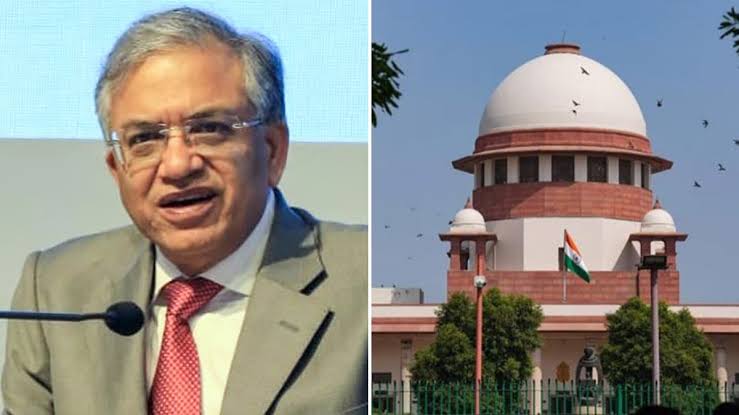
The Supreme Court stating on 5 October that it has not approved any modifications to Form 6 being used by the Election Commission (ECI) during the Special Intensive Revision (SIR) of electoral rolls in various states has come in as a validation for the ongoing nationwide protests demanding the resignation of Chief Election Commissioner (CEC) Gyanesh Kumar.
Interestingly, the SC’s assertion runs counter to what the statement issued by the ECI on 26 September said: “The declaration attached to Form 6 for SIR has been upheld by the Hon’ble Supreme Court. For non-SIR period, the Forms applicable as per Rules (the Registration of Electors Rules 1960) will be used.” A bench of Chief Justice Surya Kant and Justices Joymalya Bagchi and V Mohana said:“Any modification to Form 6 has not been approved by us. Let’s be clear. When records are produced, we would like to see who has modified it.”The top court also issued notices to the ECI and the Centre on pleas alleging that the poll body took several decisions without the approval of the two election commissioners and said that it will annul decisions found not to be in accordance with law.
The Supreme Court’s remarks have made it all the more difficult for the government to defend Gyanesh Kumar and has validated suspicions of foul play in regards to the implementation of SIR. The groundswell of the youth’s anger at the CEC and the clamour for his resignation for disenfranchising 130 million voters through the controversial SIR of electoral rolls is fast creating conditions of a country-wide mass upsurge. It will not leave the government at the Centre unscathed as it is perceived to be the single largest beneficiary of the ill-conceived and seemingly illegal act of an individual retired bureaucrat, CEC Gyanesh Kumar. The movement that is gathering momentum across the country is reminiscent of so many others in the past, including the one launched by Jayaprakash Narayan that had toppled the Indira Gandhi government. CJP’s Abhijit Dipke has announced they will continue to raise their demand if CEC Gyanesh Kumar does not resign. Wary of criticism of police brutality after the first Jantar Mantar protest by students and youths organised by the Cockroach Janta Party (CJP) in New Delhi in June 2026, police in Delhi and Mumbai are careful not to get recorded on camera as behaving savagely with protestors this time round. However, protesters were immediately detained and bundled out of protest venues on 2 October.
Additionally, an independent lady journalist has accused Delhi Police Assistant Commissioner Vivek Bhagat of sexually assaulting her near protest site Jantar Mantar on 3 October 2026. Interestingly, the same Assistant Commissioner was promoted to the rank of Additional Deputy Commissioner on 5 October, even as the matter is under investigation by the Delhi police itself. One can only surmise how this matter will proceed, and justice will be served to the lady journalist who is herself now under investigation for raising her complaint against the officer.
Ironically, the Election Commission under Gyanesh Kumar is now busy expediting the process of restoration of deleted names and inclusion of new voters which only validates the charge of wrongdoing by the CEC keeping the two other Election Commissioners in the dark.
Meanwhile, the Kerala government, which was Gyanesh’s parent cadre state as an IAS officer, has launched an investigation into his wrongdoings before retirement. Some BJP leaders are trying to get comfort from the fact the CEC can be removed only through a tortuous parliamentary process which is heavily tilted in favour of the government which has appointed the CEC. The Opposition does not simply have the numbers to carry the motion of removal through. The legal provisions for filing an FIR against the CEC and complete investigation into complaints of mischief are also time-consuming, and the outcome is uncertain.
In retrospect, it seems the Bill to protect the CEC was pushed through primarily because those in power were aware of the risks he was taking in their interest. The main worry for the CEC and the government appear to be the massive mobilisation of the country’s youth whose faith in the judiciary and the police has eroded. The protesting youths are suspicious of the role of the government and other constitutional bodies, including the ECI and SC. They are convinced the country’s democracy is not safe in the hands of the ruling government and the institutions that have willingly or by force allowed themselves to be subservient to the powers that be. This deep mistrust and hostile mood of the people is what the rulers should be very mindful of, far more than their ability to play politics with numbers in Parliament or get favourable court verdicts.