
KALPATARU NAYAK, OP
Pattamundai: Despite government spending on educational infrastructure, many rural schools in Odisha continue to struggle with inadequate facilities, raising concerns about students’ access to a safe and conducive learning environment.
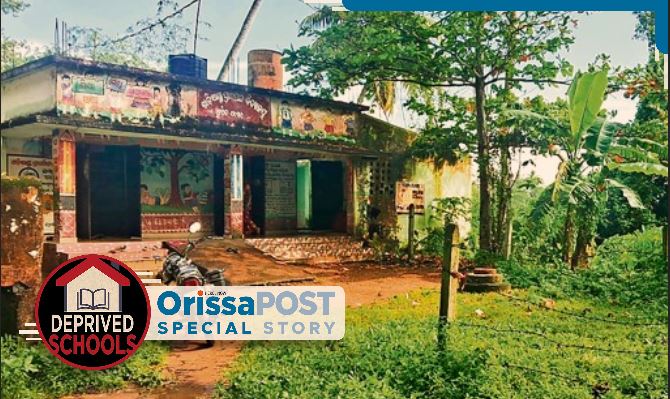
The Government Primary School at Khadianta under the Pattamundai education circle in Kendrapada district is a case in point.
Established in 1939, the school faces a shortage of teachers and classrooms, with students from all six classes, from Sishu Vatika to Class V, forced to study in a single room.
Only two teachers are available to teach the six classes.
The absence of a boundary wall has left the school premises open, while the lack of a proper playground further affects the learning environment.
The inadequate facilities have also reportedly discouraged some parents from sending their children to the school.
While 61 students were enrolled in 2023, the number has declined to 49. The school has just one room for all academic activities.
The same room is also used to store cooking utensils and other materials for preparing midday meals.
Two cupboards and two tables used to keep school records and documents occupy additional space, leaving limited space for teaching and learning.
However, separate toilets and drinking water facilities are available for students. The school is connected to the Swajal Dhara water supply project.
A weed-choked stream near the school has become a source of unhygienic conditions, while a dilapidated cyclone shelter nearby poses a constant safety concern for students, leaving parents worried.
The school has a kitchen for preparing midday meals, but its asbestos roof is damaged. Rainwater leaks into the kitchen during showers, disrupting meal preparation.
As a result, students eat their meals on the verandah.
Headmistress Pushpamanjari Biswal said the school faced several problems because of inadequate infrastructure. She said the Block Education Officer (BEO) had been informed about the problems.
School management committee president Smrutiranjan Mallik said the stream around the school was clogged with weeds and garbage, resembling a dumping ground.
“Students are forced to study in such unhygienic surroundings,” he said. Mallik pointed out that the government is encouraging students through the Sankalp campaign to keep their surroundings clean, avoid plastic use and plant trees.
However, the condition of Khadianta Primary School was contrary to these ideals. He urged the administration to take immediate steps to construct a boundary wall, appoint additional teachers and build more classrooms rather than limiting the campaign to pledges.
BEO Ajit Barik said he was aware of the problems and had informed the district administration.
Block Development Offi cer (BDO) Sheetal Agarwal acknowledged that the school faced several challenges.
She said work on additional classrooms and infrastructure development would be undertaken once funds became available