
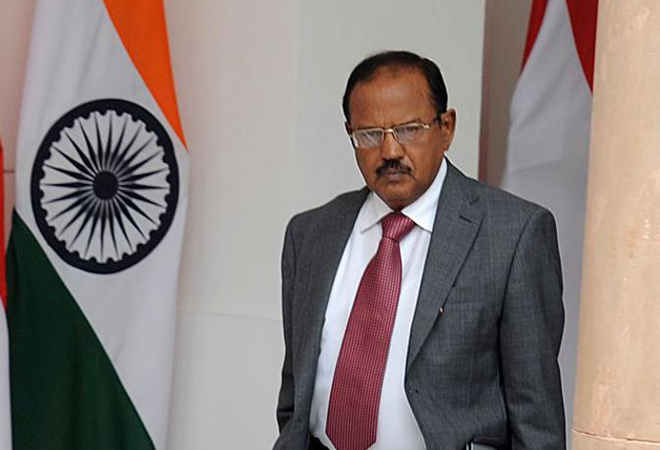
National Security Advisor Ajit Doval has called for India to strengthen itself not only along its borders but across all domains to “avenge” what he described as a painful history of attacks and subjugation. Speaking as the guest of honour at the opening ceremony of the Viksit Bharat Young Leaders Dialogue in Delhi on 10 January, the former Intelligence Bureau chief said, “Our ancestors made great sacrifices. They endured great humiliation and experienced periods of profound helplessness…Our civilisation was destroyed. Our temples were looted, and we watched helplessly as mute spectators.” This history, he said, poses a challenge that should ignite a “fire” among today’s youth. While acknowledging that “revenge” may not be the right word, he said it could serve as a powerful motivating force to rebuild India across every sphere, from security to economic and social development.
It may be argued that for a National Security Adviser, whose words are read through a strategic lens, such phrasing raises concern about whether historical suffering is being recast as a justification for present-day policies. Given the country’s current internal atmosphere of communal jingoism and internationally a humiliating helplessness, raking up historical wrongs endured by a particular community could worsen its fragile social fabric at home and impair the image globally.
Even if meant metaphorically, invoking a “painful history” risks the past being turned into a political tool where certain eras, rulers or communities are portrayed as villains, fuelling polarisation rather than shared national memory.
Also Read: 2025 – The year of reforms
Also, framing the national purpose as “historical revenge” is probably meant to lock the country into a mindset of perpetual victimhood. This will effectively distract the people from present-day woes plaguing the country, such as joblessness, inequality and rising cost of living.
It is also pertinent to note that language suggesting “avenging the past” coming from the nation’s top security officer may unsettle neighbours or allies, especially at a time when India already faces tense borders and has bad relations with almost all countries in its neighbourhood, with virtually no other nation that can be termed as an ally. The fear that such rhetoric may be misread as endorsing confrontation could be true. What might be acceptable as rhetoric from a political leader is seen as problematic coming from the country’s top security official.
History, for its part, cannot be avenged. One can only learn from it and avoid making the same mistakes. Past injustices cannot be undone, the dead cannot be restored, and suffering cannot be erased. Treating history as something to be avenged can harden grievances into ideology, turning memory into resentment rather than lessons. History then ceases to be a guide and becomes a justification for harm. Every single society in the history of the human race has been subjected to some form of atrocity. What is important is to learn from past mistakes and rebuild a society that ensures the well-being of all its people. Japan was bombed by two nuclear weapons and met a humiliating defeat in World War II. But it transformed devastation and defeat into an economic resurgence. Rather than seeking revenge, it answered history by becoming a global industrial powerhouse. Germany, too, was wrecked during World War II, but instead of lamenting and hating, it has become the strongest economic power in Europe. The Jews constantly faced genocide, pogroms and humiliation through long periods of history, but today Israel stands as a powerful nation capable of subduing the whole of the Middle East.
Present-day Indians are exposed to too much rhetoric and unnecessary chest-thumping by the country’s leadership while their lives are beset by untold economic hardships. Externally, the country’s foreign policy failures have left it alone with virtually no friends. In such trying times, our leaders and policymakers need to look into the future and adapt themselves and prepare the country to face a surprisingly new world order that has already started unfolding. America, China and Russia seem to have carved out their own spheres of influence for the future. India is yet to decide where it wants to remain relevant. It can ill afford to waste time on history just for petty domestic political gains.