
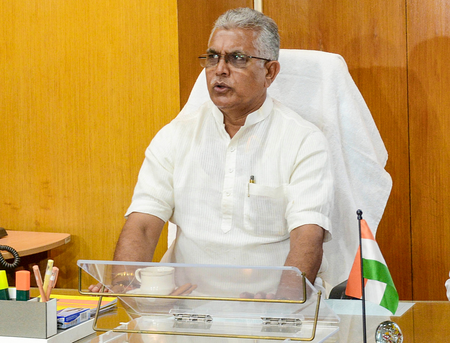
New Town (West Bengal): West Bengal Minister, Dilip Ghosh, Tuesday said that the name of West Bengal had not been changed and that ‘Poshchim Bongo’, as it is called in Bengali, should be written in every language without being translated.
Speaking to reporters, Ghosh said that names should not be translated and described the British-era practice of referring to Bharat as India as wrong.
“The name has not been changed. Whatever the name is in Bangla, Poshchim Bongo (West Bengal), the same should be written in every language. There is no translation for a name. What the British did by turning Bharat into India was wrong. Today, at the G20, where the Honourable Prime Minister sat, Bharat was written there. So, the country’s name should be Bharat across the world, and there should be no translation of it, as that is not respectful,” he claimed.
He further said that Uttar Pradesh was not referred to as the ‘Northern Province’ and Madhya Pradesh was not called the ‘Central Province’, questioning why Bengal’s name should be translated.
“Poshchim Bongo will be written, and that is how it should be,” he added.
Reacting to Leader of Opposition in the Lok Sabha, Rahul Gandhi’s, remarks advocating stronger ties and defence purchases with Israel, Ghosh said that Gandhi had realised the importance of the relationship rather late.
“Rahul Gandhi has at least realised this. He has been doing politics for so many years and should have understood this earlier. Today, Israel is so far ahead in technology and science that befriending it will benefit us in every respect. Culturally, too, it aligns with us,” he said.
He further criticised those who, according to him, had sidelined Israel for political reasons and appeasement, adding that everyone would eventually have to adopt a practical approach to politics.
Commenting on Prime Minister Modi’s announcement of a development package worth 24,000 crore Nepali rupees for Nepal, Ghosh said India had always stood by its neighbouring country in matters of trade and culture.
“India has always stood with Nepal, whether in business or culture. We share a ‘roti-beti’ bond. Nepal is a poor country situated in the mountains, and we have always supported it. India will continue to support it in the future as well. The better our ties are, the better it will be for both countries,” he said.
Orissa POST – Odisha’s No.1 English Daily