
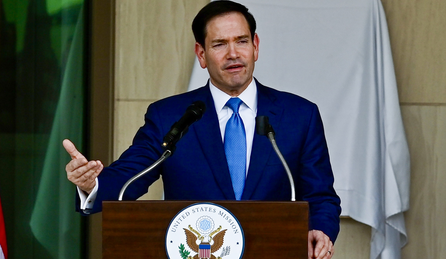
United States Secretary of State Marco Rubio’s second visit to India has ruffled quite a few feathers in New Delhi. The top US diplomat’svisit has two stops, Bombay and Jamnagar, with the national capital conspicuously missing from the itinerary.
Adding to the controversy, US Ambassador to India Sergio Gor’s remark at a public event that Washington “expected” External Affairs Minister (EAM) S Jaishankar to travel to Mumbai to meet Rubio has created the impression that India’s foreign minister was being instructed where to appear, while opposition political leaders accused the government of allowing India’s top diplomat to be “summoned” on home soil. What should have been a routine diplomatic engagement has become a political flashpoint. Visiting foreign leaders skipping the national capital, though not unprecedented, is rare.
In October 2025, then UK Prime Minister Keir Starmer had skipped New Delhi and focused his official two-day visit to India on Bombay where the Indian Prime Minister Narendra Modi had to travel to meet him. The larger question is not whether diplomats can meet outside national capitals, but whether the language and circumstances surrounding such meetings reflect mutual respect between sovereign nations. In case of Rubio’s visit, it appears that India is being instructed by America on what to do, where and how to do. In the course of his visit, Rubio is scheduled to meet senior officials to discuss the US-India strategic partnership and energy cooperation, as well as engage with business leaders, according to a US State Department statement.
Ministry of External Affairs (MEA) spokesperson Randhir Jaiswal appeared to confirm the agenda, saying the talks in Bombay would focus on energy, trade and investment, defence, and critical and emerging technologies. In Jamnagar, Rubio is expected to visit the world’s largest oil refinery, operated by billionaire Mukesh Ambani’s Reliance Industries, and attend a reception hosted by the Ambani family. Not just the itinerary, even the timing of the visit is significant. With American fuel prices becoming a political concern ahead of the November midterm elections, the visit could also serve the Trump administration’s domestic economic interests. Also, Reliance, the biggest buyer of Venezuelan crude oil besides the US, is investing in a new refinery in Texas, the first to be built in America in 50 years.
Rubio’s visit, particularly the emphasis on energy cooperation, appears to project America’s economic concerns vis-à-vis oil, which is facing pressure due to America’s war on Iran. The war has sent oil prices soaring the world over and crippling economies of developing countries like India. Ever since President Trump began his second term in White House, India-US relations have been strained by trade disputes, America’s punishing tariffs on Indian goods and Washington’s objections to New Delhi’s purchases of Russian crude oil. The Trump administration has repeatedly sought to use economic leverage to influence the decisions of other countries, including, to a great extent, India.
The Indian government’s foreign policy apparatus faces a test of credibility. It is obvious that US administration’s policy towards India is more reliant on Reliance than on what the Gov’t of India plans. India’s external policy has repeatedly presented India as an emerging global power capable of engaging Washington, Moscow and Beijing on its own terms but all the other three countries have not shown any sign of reciprocation or acknowledgement. Rubio’s visit to Bombay and Jamnagar clarifies where the US lays more importance. Strategic autonomy cannot remain a slogan invoked at public rallies while the government avoids explaining embarrassing diplomatic developments as the recent one. A confident foreign policy requires calm transparency, firmness where necessary and an ability to defend national interests without theatrical posturing. Sadly, India’s foreign policy has been reduced to the Prime Minister’s perceived good rapport with world leaders, while the country’s interests and sovereignty have been pushed to the back burner. The directionless foreign policy has made enemies out of India’s neighbours, while world powers treat the country not as a sovereign nation but as a subordinate.