

Bhubaneswar: While Odisha has traditionally faced the threat of cyclones originating in the Bay of Bengal, a scientific assessment has drawn attention to another natural hazard—earthquake vulnerability, particularly in the eastern parts of Bhubaneswar.
A detailed seismic microzonation study by the National Centre for Seismology (NCS) has identified moderate to high seismic hazard in the eastern belt of the state capital, particularly along the Kuakhai and Daya river systems.
The findings raise concerns over the seismic safety of high-rise buildings, bridges and other critical infrastructure in these areas, underscoring the need to factor earthquake risks into construction planning and infrastructure design.
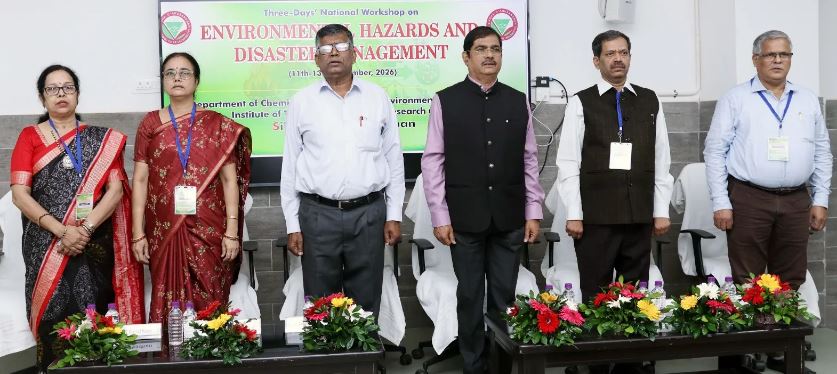
Releasing the findings at the inauguration of a three-day national workshop on ‘Environmental Hazards and Disaster Management’ at SOA Deemed to be University Wednesday, NCS Director Dr G Suresh said Bhubaneswar’s eastern areas required greater attention in earthquake-resistant construction because of their underlying soft soil conditions.
“Odisha is a region of moderate seismicity, but even an earthquake of moderate magnitude can cause extensive damage in a densely populated city with vulnerable buildings,” he cautioned.
Dr Suresh said Odisha falls under Seismic Zones II and III of the Bureau of Indian Standards (BIS) seismic zoning map.
The Mahanadi valley, extending from Jharsuguda and Sambalpur through Anugola, Katakak, Bhubaneswar, Paradip and Puri, falls under Zone III, categorised as a moderate-risk zone, while most other parts of the state are in Zone II, a low-risk category.
Highlighting Odisha’s earthquake history, he recalled that a tremor of approximately magnitude 6, originating in the Bay of Bengal, was felt along the state’s coast in May 2014.
Sambalpur experienced a magnitude 5.2 earthquake in 1963, while earthquakes measuring 4.6 and 4.7 were recorded in the Bonaigarh-Debagada region in 1995 and Sundaragada in 2001, respectively.
The NCS monitors seismic activity round the clock through a network of 180 observatories across the country, including three in Odisha at Bhubaneswar, Jharsuguda and Rayagada.
These observatories can detect and locate earthquakes of magnitude 3 and above, he said. multiplying the intensity of shaking,” Dr Suresh explained.