
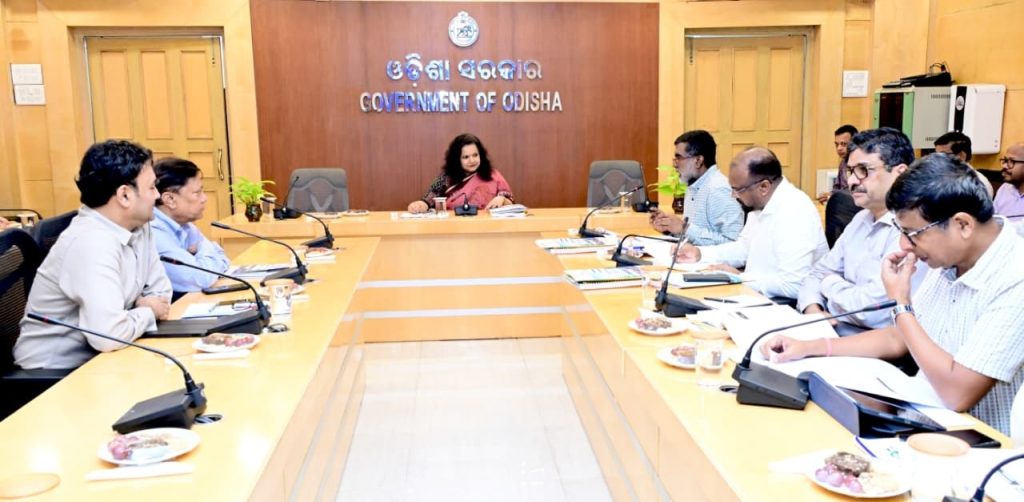
Bhubaneswar: Odisha will prepare a comprehensive Fly Ash Atlas to scientifically manage the generation, availability and utilisation of fly ash and map its movement from producers to end users, Chief Secretary Anu Garg said Thursday. The initiative aims to make fly ash management more scientific and effective by creating a clear database of its generation, availability and demand across the state. The decision was discussed at the 135th Board meeting of the Odisha State Pollution Control Board (OSPCB) held here Thursday.
The meeting, chaired by Garg, also decided to take forward research on biostabilisation and biotransformation of fly ash in collaboration with research and educational institutions. The board reviewed a range of measures to strengthen the institutional and technical capacity of the OSPCB, modernise its laboratory infrastructure, promote research and reinforce coastal environmental monitoring. Special emphasis was given to a proposal to develop the Centre for Management of Coastal Ecosystem (CMCE) at Paradip as a Centre of Excellence for coastal environmental monitoring and analysis. “The centre at Paradip should not remain merely a laboratory but should be developed as an integrated centre of science, data and technology for the protection of the coastal environment,” Garg said. The meeting discussed proposals for construction of dedicated regional office buildings of the OSPCB at Ka taka, Jharsuguda, Koraput, Kalinganagar, Bhubaneswar, Kendujhar and Sambalpur, besides modernisation of the Patia-based laboratory. Garg stressed that the new infrastructure should give priority to green building practices, rainwater harvesting, solar energy and vermicomposting. The meeting also discussed the establishment and operationalisation of an Interpretation Centre as part of efforts to strengthen environmental awareness and outreach.
To make environmental monitoring faster and more data-driven, the board discussed setting up a Command and Control Centre at the OSPCB headquarters. The proposed centre will integrate laboratory data, water sample testing results and field inspection information to facilitate rapid analysis and improve decision-making. The board also laid emphasis on expanding water sample collection and monitoring through robotic technology and widening the scope of field inspections with the use of drones. Garg called for coordinated efforts to build a science-based, technology-enabled, clean and citizen-centric environmental governance system in Odisha.
Orissa POST – Odisha’s No.1 English Daily