
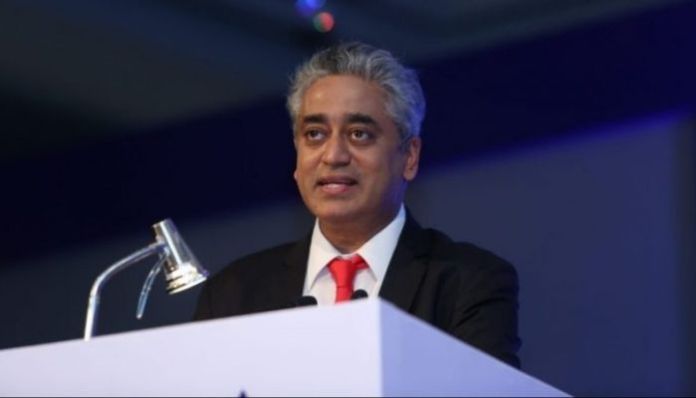
By Rajdeep Sardesai
So who is in charge of India’s foreign policy? On the face of it, that would seem a pretty obvious answer. Dr S Jaishankar as EAM has been the highly visible public face of the Modi government, a peripatetic and seasoned diplomat who has often made headlines for his sharp and pointed sound bites. And yet, there have been enough moments when even the media-savvy minister must wonder just who is calling the shots in South Block. The latest in stance of diplomatic confusion is exemplified by the handling of relations with Bangladesh. Consider this.
On 31 December, Jaishankar travelled to Dhaka to attend the funeral of former Bangladesh PM Khaleda Zia, handing over a personal letter of condolence from PM Modi to her son and heir apparent Tariq Rahman. The image of the minister shaking hands with the man most likely to be Bangladesh’s next PM suggested a thaw in ties after months of frosty relations. Yet, just two days later, the BCCI issued a directive to the IPL franchise Kolkata Knight Riders (KKR) asking it to withdraw the Bangladesh star player, Mustafi zur Rahman, from its list of contracted players. The private franchise complied without demur, sparking off an angry reaction from Bangladesh government and cricket board, which has now declared that it will not play the World T20 matches in India next month as a mark of protest. So here is the question: what changed in 48 hours between a significant high-level diplomatic engagement and a sudden ineplicable decision to target an individual cricketer? The only apparent shift is the high-decibel campaign launched by so-called ‘fringe’ Hindutva elements calling on the Modi government to get tough with Dhaka against the backdrop of cases of attacks on Hindus in Bangladesh. BJP UP MLA, Sangeet Som specifically targeted KKR owner Shahrukh Khan, accusing him of being a ‘gaddar’ for having signed up Mustafizur. Som got his momentary prime time fame by dragging the superstar into the controversy.
In normal times, a rational, level-headed government would have ignored the rants of the ‘fringe’, but in ‘new’ India, the Hindutva fringe is now ‘mainstream’, and a government that is fuelled by toxic religious politics cannot ignore the social media army that propels it forward. When this social media outrage begins to influence sensitive foreign policy choices, then it enters a very dangerous terrain. This isn’t about making the usual trite argument about the need to separate sports and politics. Such distinctions are impossible to make at a time when sports, especially cricket in the sub-continent context, is a graphic demonstration of Indian ‘soft power’ to the wider world. The BCCI exercises hegemonic dominance over the cricket world with Home Minister Amit Shah’s son, Jay Shah the president of the International Cricket Council and easily the most powerful man in the sport. Then be it refusing to shake hands with Pakistani players at the Asia Cup or now ostracising a Bangladesh player, Indian cricket calls the shots. That ‘superpower’ status is now being used, rather misused, to play big bully on behalf of the government. Indeed, the decision to remove Mustafizur wasn’t even taken after consulting the IPL Governing Council but instead seen as an urgent firman from the political leadership. Which brings one back to the original question: who is deciding Indian foreign policy? India’s practised diplomatic corps or the home minister and the BJP’s sangh parivar brotherhood in saffron? The former have to often walk a delicate tightrope, patiently balancing national interests within a larger framework of achieving credible strategic goals in the neighbourhood.
By contrast, the netas and their supporters have no such constraints. There is an election in Assam and West Bengal just months away and ratcheting up anti-Bangla desh sentiment is seen as a use ful weapon to win votes. Where a nuanced diplomatic policy would strongly protest the at tacks on Bangladeshi Hindus without making it a prime time spectacle, the political leadership and their cheerleaders prefer riding a wave of emotion that they hope will grab headlines and earn them electoral dividend.
Consequently, rather than building bridges with Dhaka, we have only created a wall of mistrust and an gerthat could only exacerbate an already fraught situation, further emboldening Islamic fanatics in that country. Imagine the embarrassment now if Bangladesh doesn’t come to play in India or prefers neighbouring Sri Lanka as a ‘safer’ country. Nor is Bangladesh an isolated example of ad-hoc foreign policy choices being driven by sentiment rather than common sense. In 2024, there was an entirely avoidable spat with tiny Maldives sparked off by incendiary tweets on both sides. It eventually required diplomatic finesse to slowly paper over the cracks.
Last year, in the immediate aftermath of Op Sindoor, the Modi government revoked the security clearances for Turkish airport ground handling firm, Celebi, citing national security concerns. It was again a sudden decision taken against the backdrop of Turkey being accused of siding with Islamabad in the war against India. Here again, a more refined foreign policy would have avoided an instant confrontation with Ankara but the impatient social media warriors have no time for any complex, well-considered messaging.
Perhaps the most obvious example of just how an inconsistent foreign policy matrix is influenced by rabble-rousers is provided by New Delhi’s initial response to Beijing in the aftermath of the Galwan clashes in 2020. From banning Tik-Tok to calls for boycotting Chinese goods, the right-wing internet’s perpetually angry brigade determinedly sought to escalate the conflict by taking measures that were frankly no deterrent to an expansionist regime. Five years later, the BJP-RSS leadership is hosting a visiting Chinese Communist Party delegation, treating the engagement as routine politics. When the Congress engaged with Beijing’s political class, their leadership was accused of betraying national interests. Now, it’s business as usual. The hypocrisy is staggering. Post-script: At the mall a few days ago, I saw a group of young men lining up to buy sweaters at highly discounted prices. As they furiously shopped, I noticed that the sweaters carried a ‘Made in Bangladesh’ tag. So much easier to target a cricketer than a textile manufacturer.
The writer is senior journalist and author.