
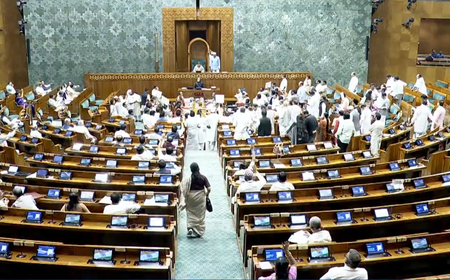
New Delhi: The government will bring ‘The Delimitation Bill, 2026’ to replace the 2002 law during the special sitting of Parliament this week, under which the Centre would have the power to constitute a delimitation commission to distribute the seats in the Lok Sabha and Legislative Assemblies on the basis of the “latest census figures”.
The bill has been circulated among Members of Parliament along with ‘The Constitution (One Hundred and Thirty-First Amendment) Bill, 2026’ and ‘The Union Territories Laws (Amendment Bill), 2026′ in an exercise aimed at operationalising the women’s reservation law by 2029 elections.
Several of the provisions of the new delimitation bill are similar to the 2002 law, which would be repealed.
According to the draft Delimitation Bill, 2026, “The Central Government may, from time to time, by notification, constitute a Commission to be called the Delimitation Commission.
“The Commission shall comprise of the following members, namely: one member, who shall be a person who is or has been a Judge of the Supreme Court, to be appointed by the Central Government, as the Chairperson of the Commission; the Chief Election Commissioner or an Election Commissioner nominated by the Chief Election Commissioner, ex officio’ and the State Election Commissioner of the State concerned, ex officio.”
The central government may, by notification, specify the term of the Commission, the bill says.
The central government may, on the request of the Commission, extend the term of the Commission by such further period as it may consider necessary, it says.
“The Election Commission shall act as Delimitation Commission for the purpose of delimiting constituencies in the Legislative Assembly of the Union territory of Jammu and Kashmir falling under the occupation of Pakistan, when the area of the Union territory of Jammu and Kashmir under the occupation of Pakistan ceases to be so occupied,” the bill says.
“It shall be the duty of the Commission to readjust, on the basis of the latest census figures, the allocation of seats in the House of the People to the States and Union territories, the total number of seats in the Legislative Assembly of each state and the division of each state and Union territories into territorial constituencies for the purpose of elections to the House of the People and to the Legislative Assembly,” the draft law says.
The bill also states that the Commission shall associate with itself for the purpose of assisting it in its duties in respect of each state, ten persons, five of whom shall be members of the House of the People representing that state and five shall be members of the Legislative Assembly of that state.
“Provided that where the number of members of the House of the People representing any state is five or less, then, all such members shall be the associate members for that state and in the latter case the total number of associate members shall be less than ten by such number as by which the total number of members of the House of the People representing that state is less than five,” it says.
The persons to be so associated from each state shall be nominated, in the case of the members of the House of the People, by the Speaker of that House, and in the case of members of a Legislative Assembly, by the Speaker of that Assembly, having due regard to the composition of the House or, as the case may be, of the Assembly.
The bill gives the Commission the power to call upon the Registrar-General and Census Commissioner, India or his nominee; or the Surveyor General of India or his nominee; or any other officer of the central government or state government; or any expert in geographical information system; or any other person.
“The Commission shall, in the manner herein provided, distribute the seats in the House of the People allocated to each state and Union territory and the seats assigned to the Legislative Assembly of each state to single-member territorial constituencies and delimit them on the basis of the latest census figures, having regard to the provisions of the Constitution,” the bill says.
It calls for constituencies, as far as practicable, to be geographically compact areas, and says that in delimiting them regard shall be had to physical features, existing boundaries of administrative units, facilities of communication and public convenience.
The draft law states every Assembly constituency shall be so delimited as to fall wholly within one Parliamentary constituency.
“The Commission shall’ (a) publish its proposals for the delimitation of constituencies, together with the dissenting proposals, if any, of any associate member who desires publication thereof, in the Gazette of India and in the Official Gazettes of all the states concerned and also in such other manner as it thinks fit; specify a date on or after which the proposals shall be further considered by it;
“Consider all objections and suggestions which may have been received by it before the date so specified, and for the purpose of such consideration, hold one or more public sittings at such place or places in each state as it thinks fit; and thereafter by one or more orders determine the delimitation of Parliamentary constituencies; and the delimitation of Assembly constituencies, of each state,” it says.
The provisions of this Act shall have overriding effect, notwithstanding anything contained in any other law for the time being in force, in respect of duties, powers and functions of the Commission under this Act, it further says.
Orissa POST – Odisha’s No.1 English Daily