
New Delhi: The government introduced a Bill in the Lok Sabha Monday to amend the regulations for mines and minerals, whereby states will be restricted from levying additional tax on mineral rights.
With the Mines and Minerals (Development and Regulation) Amendment Bill, 2026, the Centre also seeks to take under its control the regulation of mineral-bearing lands having mineral contents in accordance with the parameters prescribed under the MMDR Act.
“This is in addition to the existing provision which declares the Union’s control over the regulation of mines and the development of minerals,” according to the Bill’s Statement of Objects and Reasons.
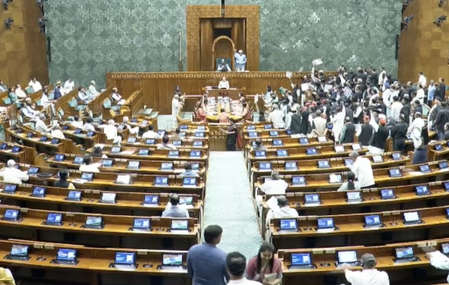
Minister of Coal and Mines G Kishan Reddy introduced the Bill amid protests by opposition members over various issues.
The Bill states that “no tax, cess or such other levy (by whatever name called) shall be imposed by the state government on mineral rights”.
The provisions would also apply to mineral-bearing lands, either based on mineral quantity, mineral value, royalty or otherwise, except in accordance with such conditions or restrictions as may be prescribed by the central government.
A new section is to be inserted in the Mines and Minerals (Development and Regulation) Act in this regard.
Besides, the Bill proposes to provide that any such tax, cess or other levy which is not deposited with the state government or recovered by it before the commencement of the MMDR (Amendment Act), 2026, would be deemed to be invalid at all material times.
“However, any such tax, cess or other levy on mineral rights or on mineral-bearing lands, already deposited with the state government or recovered by it before such commencement, shall not be liable to be refunded,” the Bill said.
In the Statement of Objects and Reasons, Reddy said these amendments strive to provide certainty, stability and predictability in the fiscal regime in the mineral sector, thereby giving impetus to national economic growth which would facilitate the aims of Atmanirbhar Bharat and ultimately attaining the vision of Viksit Bharat 2047.
He said any regional disparity in fiscal impositions on minerals impacts public interest and that unbalanced imposition of steep taxes and levies will prompt the industry to completely bypass local supply lines, leading to sub-optimal development of markets, increased transportation costs and the resultant pollution load.
“There is also a risk of an increase in imports of minerals despite having sufficient local mineral resources as domestic mineral supply becomes expensive,” the minister said.
He also mentioned that uneven imposition of taxes on mineral rights and mineral-bearing lands by the state governments in the absence of reasonable limitations has resulted in various issues.
“An excessive tax burden at the extraction stage or otherwise may ultimately increase the cost of goods and services and, consequently, the cost of living for the common citizen in the country. Further, any retrospective imposition of taxes would cause legal uncertainty and erode investors’ trust,” Reddy said.
RSP leader N K Premachandran opposed the introduction of the Bill, saying it is against federalism.
PTI