
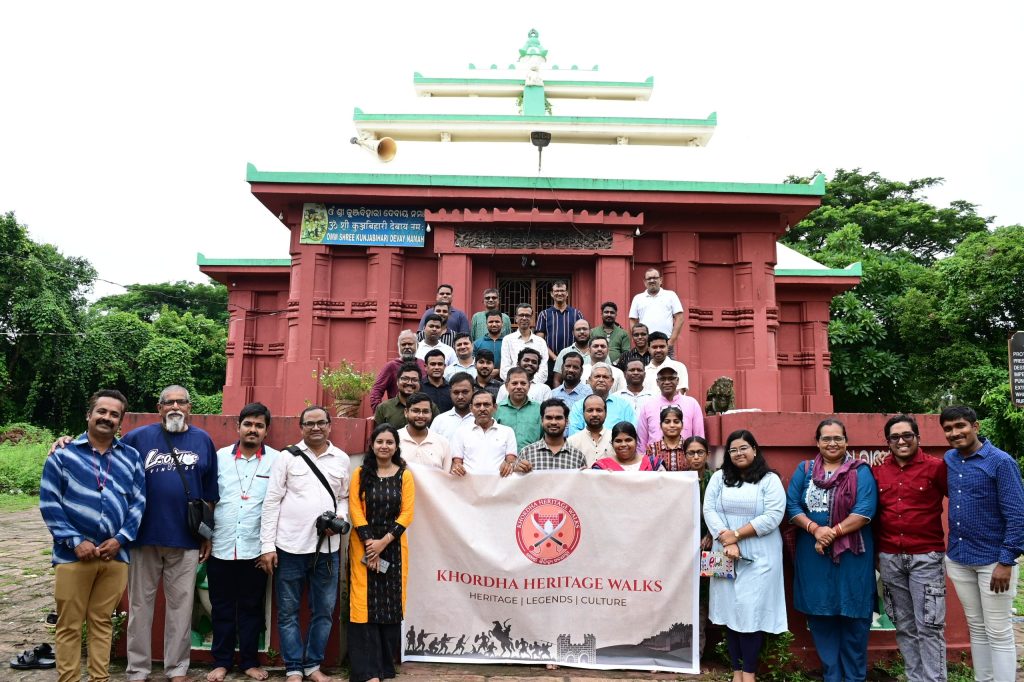
Khordha: The first Khordha Heritage Walks was organised at historic Gada Khordha, bringing together heritage enthusiasts and explorers from across Odisha to highlight the region’s rich historical and cultural legacy.
The walk began at Kunjabihari Temple, where participants were introduced to its historical and architectural significance. Senior Khordha intellectual Bimal Kumar Sarangi spoke about Khordha’s important place in Odisha’s history, including the arrival of the first Bhoi dynasty ruler, Raja Ramachandra Deva, and the establishment of Khordha Fort.
Writer and heritage enthusiast Prof Gopal Chandra Das highlighted the temple’s association with Lord Jagannath. According to local tradition, during the first Nabakalebara, Lord Jagannath briefly stayed at the site while travelling towards Brahmapur. Maharaja Ramachandra Deva later constructed the temple to commemorate the association.
Built in the traditional Pidha style, the temple features intricate sculptures depicting horse-riding women and soldiers. Radha-Krishna are the presiding deities, while Trivikrama, Varaha and Narasimha are worshipped as subsidiary deities. Marks believed to have been left by bullets during the British campaign against Khordha are still visible on the temple.
The walkers next visited Jagannath Lilakshetra, associated with traditions of Lord Jagannath being taken towards Chilika for protection from external attacks, and Govindajew Math, linked to Sakshigopal’s journey from Kanchi to Odisha. Participants noted poor access to the site and the neglect of an old Odia-style structure.
The trail then covered the historic Khordha Fort and Rajabati complex, where participants learned about Raja Ramachandra Deva’s establishment of the fort and its strategic hill location. A museum is being developed with government assistance, while restoration of Rani Pokhari is underway.
The role of Barunei Hill and Paika warriors in resisting the British attack on Khordha was also discussed. The walk further covered Buxi Pokhari, the pond near Raghunath Dev Temple, Vrindavan Dev Math, Raghunath Temple and Nilakantha Temple.
Participants expressed concern over the deteriorating condition of several ancient sculptures, including Ananta Shayana and Narasimha carvings.
At the Radhakanta Dev Temple, participants learned about traditions associated with Buxi Jagabandhu and examined its distinctive Pidha-style architecture. Participants also raised concerns over vegetation, rainwater leakage, waterlogging and poor maintenance affecting the temple and its surroundings.
The organisers announced that the KHW will be held on the fourth Sunday of every month, providing a regular platform for exploring, documenting and creating awareness about the region’s heritage.
Heritage walk conveners and enthusiasts from Kataka, Puri, Dhenkanal, Jagatsinghpur and Ganjam also participated in the inaugural event. Senior advocate and cultural researcher Shakti Prasad Mishra, journalist Samarendra Baliarsingh and several local heritage enthusiasts were among those present.