
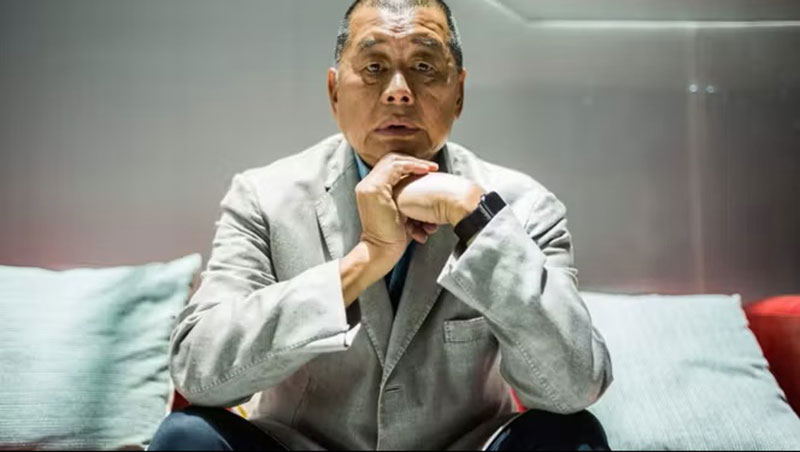
The last nail into the coffin of whatever freedom is believed to be there in Hong Kong, a unique territory in the Chinese world, was driven, when the judges appointed by authorities loyal to Beijing pronounced an exceptionally harsh sentence of 20 years in prison for pro-democracy activist and former media mogul Jimmy Lai. It was a foregone conclusion during the two years of his trial that he would be convicted. There was not a shadow of doubt that the National Security Law, imposed over five years ago to quell dissent against the harsh Beijing overlordship, would be used to make him an example for the fate that would befall anyone else not toeing China’s line. Lai was one of the first arrested in August 2020, just a month after this new repressive legal order came into force. Lai became a symbol of resistance to Chinese autocratic rule. He never sought to apologise for his criticism of the regime or for his contacts with Taiwanese democrats and American officials standing by Taiwan. But his 20-year sentence, at the age of 78, is the bitterest pill for the citizens of Hong Kong who find the space of their political freedom shrinking by the day. Its press has already declined in quality, its most independent bookstores have closed and university professors are reportedly in a fix about what they can say in the classroom. The national security law has completely transformed life in Hong Kong, an international financial hub that was promised its civil liberties would be preserved for 50 years after the 1997 handover of the former British colony to China. Most of the city’s pro-democracy figures have either been imprisoned or left politics, while some of them, who are lucky enough, have moved out abroad.
Last year, Hong Kong ranked 140th out of 180 countries and territories in Reporters Without Borders’ World Press Freedom Index. This is a massive and alarming fall as it had been placed 18th in 2002. The sentence on Lai, which effectively consigns him to prison for life, shows how ruthless and devoid of humanism Chinese rule could be, however much the authorities in Hong Kong claim or pretend that mainland China was not involved. The record says it all. Human rights lawyer Xu Zhiyong was sentenced to 14 years in prison in 2023, Uyghur intellectual Ilham Tohti to life imprisonment in 2014 and citizen journalist Zhang Zhan, who dared to publish videos from Wuhan at the start of the CoVID-19 pandemic, to two consecutive four-year terms.
Since Chinese President Xi Jinping imposed the National Security Law, critics have either fled to London or Taiwan fearing reprisals from Beijing. Both the UK and the US are so busy with their respective geopolitical calculations centering round China that they appear to have forsaken Lai at this critical juncture. British Prime Minister Keir Starmer, who had travelled to Beijing and Shanghai at the end of January, only sheepishly told the media he had raised the issue before Xi.
US President Donald Trump is scheduled to visit China in April and his Secretary of State Marco Rubio mouthed the pious platitude that Lai’s sentence “shows the world that Beijing will go to extraordinary lengths” to silence its critics. Trying to be diplomatically correct he urged the authorities to grant Lai humanitarian parole. China today is the most sought after global power after Trump’s mindless trade war directed against both his friends and foes. As such no accusing finger can be raised against Beijing for its design on Hong Kong and the superpowers seem to have decided to merrily go on consolidating and annexing, wherever possible, their respective spheres of influence.