
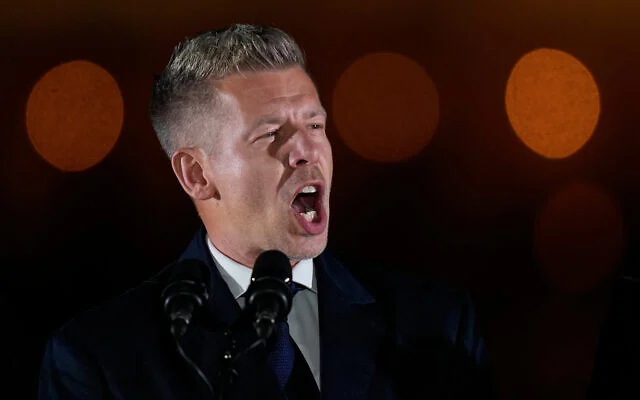
The landslide victory of Hungary’s opposition Tisza party, led by Peter Magyar April 12, bringing an end to Prime Minister Viktor Orban’s 16-year grip on power is a major blow to Far-Right politics across Europe. Orban had, over the years, become a poster boy of all the ills that his brand of extreme politics represented. It is jolt for US President Donald Trump whom Orban was beholden to while, at the same time trying to get close to Russia’s Vladimir Putin.
During the election campaign, Trump even directly asked Hungarians, in a dramatic phone call made by Vice President JD Vance in Budapest at a rally, to vote for Orban and he promised to pump in huge capital for the country. The election results have come at a crucial time and the country’s relationship with the EU is going to be reset. With 98.74% of the votes counted, Magyar’s Tisza party was projected to have won 138 of the 199 seats in the country’s Parliament, giving them a super-majority capable of amending the constitution and key laws. This will enable Tisza to reverse some of the changes made by Orban and his party Fidesz which won 55 seats, while the extreme-right Mi Hazank party won six. The results were only expected as Hungarians appeared to have been fed up with the extremist policies of Orban that led to unbridled corruption, ruthless suppression of free speech and appointment of judges to ratify Orban’s policies whenever they were legally challenged.
These are all elements of typical Far-Right politics with an unmistakable Trumpian stamp. The popular discontent first arose from inflation of more than 40% since 2022 and a sluggish economy, hit both by the suspension of 18 billion in European Union funds and by endemic corruption that scared off foreign investors and discouraged Hungarian entrepreneurship. Having already lost the support of liberal voters in Budapest, Orban had also alienated small business owners and middle-class professionals, who long formed the core of the electorate for Fidesz. Many would be able to observe similarities of the Hungarian situation with the current Indian economic picture. Foreign investors are fleeing India on a daily basis. When he realised there had been erosion of his main vote bank, Orban resorted to a policy of overtly supporting Russia making Ukraine and its President Volodymyr Zelensky Hungary’s main adversaries.
Hungarians mostly were not supportive of Kyiv. However, they do not, at the same time, believe that Ukraine poses any serious threat to their country. This is contrary to the narrative pushed throughout the campaign by the government’s propaganda machine. Thus, Orban’s war cry for this election went unheeded. The youth of the country were particularly disenchanted with Orban’s brand of politics, especially since, unlike Orban, they have no wish to leave the European Union. On the other hand, Magyar pledged to repair Hungary’s strained relationship with the EU, crack down on corruption and funnel funds towards long-neglected public services. This tilted the balance overwhelmingly in his favour. He hailed the victory with the jubilant cry – “My fellow Hungarians, we have done it!,” – as he thanked tens of thousands of supporters who had gathered along the banks of the Danube river to celebrate. This marked the fall of another strong Rightist leader. The election was being closely watched around the world as a test of the resilience of the global Far-Right, many of whom have looked upon Orban as their role model. Trump had repeatedly endorsed Orban. In recent months, Orban got support from right-wing and Far-Right leaders ranging from France’s Marine Le Pen to Italy’s Giorgia Meloni and Israel’s Benjamin Netanyahu.
However, realising the significance of Orban’s defeat, Meloni promptly congratulated Magyar. In fact, leaders from across Europe hailed the result, with Keir Starmer describing it on social media as a “historic moment, not only for Hungary, but for European democracy”. The development in Hungary sends out the message loud and clear that Far-Right politics experimented in the country for long 16 years could not solve people’s problems, including livelihood, health and education. It also shows the Far Right is now on back foot. The divisive and polarisation politics creates more problems than it solves despite manipulation of media, the judiciary and use of muscle power. The same ills are plaguing many countries, including India, and now Hungary has shown where the world is headed. The wheel, it seems, has taken a complete turn.