
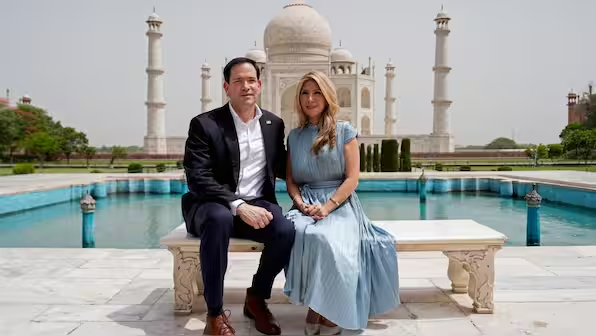
New Delhi: US Secretary of State Marco Rubio’s visit to the Taj Mahal Monday drew a sharp reaction from an Iranian consulate in India, which said, “if Rubio knew” its history or architecture, “he wouldn’t have posed for a picture” at the monument in Agra.
The remark by Iran’s Consulate General in Hyderabad, which came against the backdrop of the West Asia conflict between Iran and the US-Israel combine, sought to highlight the ‘Persian link’ of Mughal-era architectural marvel as well as Mumtaz Mahal — wife of Emperor Shah Jahan who built the iconic structure in the 17th century in her memory
In a post on X, the mission shared a photo of the Rubios sitting at the historical site with the Taj Mahal behind, and wrote: “If Rubio knew the history or architecture, he wouldn’t have posed for a picture here.”
It apparently sought to highlight the ‘Persian link’ of Mughal-era architectural marvel as well as Mumtaz Mahal — the wife of Emperor Shah Jahan, who built the iconic structure in the 17th century in her memory.
“This monument was built out for the love of emperor’s Iranian wife, crafted by the genius of Iranian architects – meanwhile, his government today threatens to wipe out Iranian civilization, insulting other civilizations,” the consulate posted on X.
Iran, in ancient times, was referred to as Persia, and Persian art and language found patronage during the Mughal rule in the Indian subcontinent.
Rubio, along with his wife, Jeanette Rubio, visited the Taj Mahal on a rather hot summer Monday morning, and described the famed Mughal-era monument as “one of the love treasures of the world.”
The current West Asia conflict was triggered by US-Israel combine launching air strikes on Iran on February 28.
Washington and Tehran have been accusing each other of prolonging the conflict, amid attempts to forge peace.
Rubio’s visit to the Taj Mahal in Agra and the Amber Fort in Jaipur came in between a packed itinerary for his India visit.
According to Britannica Encylopedia’s website, the construction of the Taj Mahal commenced around 1632, and the massive complex was completed over a period of 22 years.
Mumtaz Mahal died in Burhanpur and was buried at the Taj.
Thousands of workers were employed from India, Persia and other places to complete the mausoleum, the adjunct buildings, and ornamentation work, it says.
According to a website dedicated to the Taj Mahal, run by the Uttar Pradesh government, throughout the complex, passages from the Quran have been used as decorative elements.
Arabic inscriptions in black marble have been used to decorate both the south gateway and the main mausoleum.
Mumtaz Mahal was born as Arjumand Banu Begum in 1593 in Agra. Her father, Abdul Hasan Asaf Khan, was “a Persian noble,” the website says in her profile section.
Her father was the brother of Empress Nur Jahan (who was the wife of Mughal Emperor Jahangir).
Betrothed to Prince Khurram (later Emperor Shah Jahan) in 1607 at the age of 14, she was married five years later in 1612, it adds.
Empress Nur Jahan’s father was Mirza Ghiyas Beg, who was a trusted treasurer in Akbar’s court.
Beg was a poor merchant who “lived in Persia,” and rose through the ranks to become the chief minister during Jahangir’s reign, says the website of Agra Development Authority (ADA).
He was given the epithet Itimad-ud-Daula, or the ‘pillar of the state’.
The Tomb of Itimad-ud-Daula, another architectural icon of Agra, was constructed by Nur Jahan between 1622 and 1628, it says.
The tomb situated on the banks of the Yamuna is also known as the ‘baby Taj’.
Orissa POST – Odisha’s No.1 English Daily