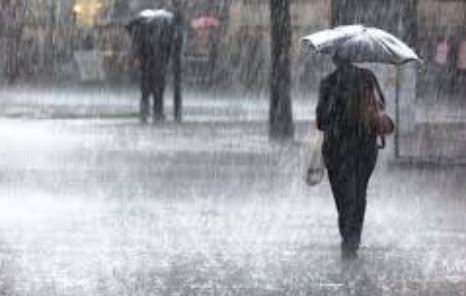
New Delhi: Southern and central India are expected to witness good rainfall from January to March, while the northwest region comprising Punjab and Haryana is likely to get below-normal showers, the weather office said Thursday.
However, the mixed rains forecast was unlikely to have an impact on the rabi crop as the northwestern parts of the country are well irrigated and good monsoon rains have resulted in reservoirs being full, Mrutyunjay Mohapatra, Director General of the India Meteorological Department (IMD), told a press conference here.


He said the northeast, parts of Bihar and Vidarbha will experience one to three days of additional cold days, while Rajasthan is expected to witness fewer cold days.
Mohapatra said the monthly minimum temperatures in January are likely to be below normal over most regions of the country. However, some parts of northwest and northeast India, as well as peninsular India, are expected to experience above-normal temperatures.
The weatherman attributed a virtually dry December to the absence of western disturbances that are known to bring rain and thunderstorms to the northwestern and central regions.
The western disturbances are either moving towards the north or moving too fast, Mohapatra said, attributing the change in pattern to climate change.
However, he said less snow cover during December to March was one of the indicators for good rains during the southwest monsoon season.
Mohapatra said La Nina conditions — the cooling of the sea surface in the equatorial Pacific region — are prevailing at present, and global forecasting models have predicted ENSO neutral conditions by March.
The ENSO neutral conditions are likely to remain dominant till June-July, he said, suggesting that it is an indicator of good monsoon rainfall.
Mohapatra said 2025 was the eighth-warmest year since 1901, with the all-India annual mean land surface air temperature being 0.28 degrees Celsius higher than the 1991-2020 long-term average.
The warmest year on record was 2024, when temperatures across India were 0.65 degrees Celsius above the long-term average.
Mohapatra said the all-India seasonal mean temperatures were above the long-term average during the winter (January-February) and pre-monsoon (March-May) seasons, with anomalies of 1.17 degrees Celsius and 0.29 degrees Celsius, respectively.
During the southwest monsoon (June-September) and post-monsoon (October-December) seasons, seasonal mean temperatures were near the long-term average, with anomalies of 0.09 degrees Celsius and minus 0.1 degrees Celsius, respectively.