
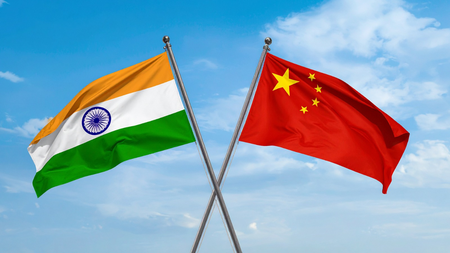
Despite the newfound bonhomie between China and India in the wake of US President Donald Trump’s tariff war, China is back to its old game of needling India at the slightest op portunity by claiming Arunachal Pradesh as Chinese territory.
This time it has raked up the issue in a crude, arrogant, undiplomatic and insensitive way, subjecting a woman, Pema Wangjom Thongdok, hailing from the state and working in the UK, to an 18-hour ordeal at the Shanghai airport recently. The incident has confirmed the suspicion that China is actually trying to take advantage of the plight of India, facing huge, nearly insurmountable tariff barriers put up by the US, while pretending to be willing to make a common cause with India against Trump. When China unveiled its version of the US H-1B visa for Indian techies and scientists willing to work there after the US’ steep tariff and incredible hike of the H-IB visa, it was feared China would try to arm-twist India over border disputes. But it could not be imagined that China would provoke India so soon. This incident is highly surprising after Prime Minister Narendra Modi met China’s President Xi Jinping during a Shanghai Cooperation Organisation (SCO) summit in China only a few weeks ago.
India had to issue a “strong demarche” to China after a woman from Arunachal Pradesh had been harassed and stopped by Chinese immigration officials at the Shanghai airport. The officials ridiculed her and told her to “apply for a Chinese passport” since Arunachal Pradesh “belongs” to China. Pema Thongdok, a principal regulatory consultant working in financial services in London, told the media she was detained at Shanghai airport for 18 hours, and immigration and airlines staff were “unprofessional and rude,” laughing and mocking at her.
The Ministry of External Affairs said the passenger had been detained on ludicrous grounds. It maintained that Arunachal Pradesh is an indisputably Indian territory and its residents are perfectly entitled to hold and travel with Indian passports. It has also been highlighted that the actions of the Chinese authorities are in contravention of the Chicago and Montreal Conventions relating to civil aviation. The woman was flying from London to Japan, transiting via Shanghai and was booked on a China Eastern Airlines flight. She has been residing and working in the United Kingdom for the past 14 years. She said she had transited via China in October 2024 without facing any issue. Never before had she been harassed or her status as an Indian citizen belonging to the north-eastern state questioned. This makes China’s intent all the more suspect. What is more, the woman claimed she had checked with the Chinese embassy prior to her journey that a transit of less than 24 hours does not require any transit visa. She was to make a stopover of only three hours at the Shanghai airport.
However, upon arrival in Shanghai around 6 am on 21 November, immigration officers refused to allow her transit and declared her Indian passport invalid solely because her place of birth is Arunachal Pradesh. They repeatedly insisted that Arunachal Pradesh is part of China and therefore her Indian passport was invalid and not an acceptable form of document to travel.
Her passport was withheld without explanation, and she was kept in custody within the airport for nearly 18 hours without access to food, support, or proper communication. She complained that despite having a valid Japanese visa and not leaving the airside transfer area, she was denied boarding for her original flight. China Eastern and the immigration officers later told her that unless she booked a new ticket specifically on the airlines, they would not return her passport. She could contact the Indian Embassy with great difficulty and Indian officials ultimately escorted her to a flight late in the evening at 10.20 pm. The Chinese officials were cautious enough not to stamp her passport which was eventually returned to her. China of course sought to brazen it out by claiming that the woman had only been subjected to routine check, provided with food and no discourtesy was shown to her. This is typical Chinese prevarication.
At a time when India is working to improve ties in the current changed geopolitical and economic situation, such actions by the Chinese side create unnecessary obstructions to the process. It also shows that India’s response to American tariff aggression has been futile. India seems to have fallen in a helpless situation where neighbours realize that the nation is weak.