
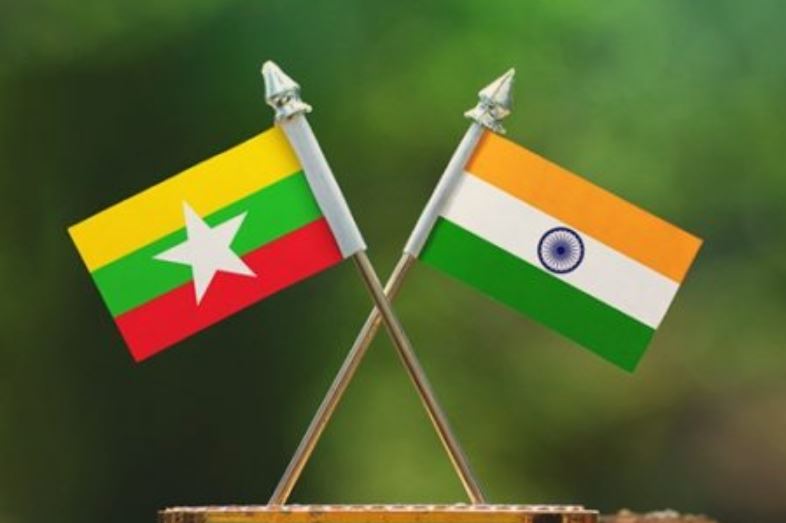
The ongoing visit of Myanmar’s President Min Aung Hlaing to India is fraught with geopolitical significance. India’s reputation as a champion of democracy is also on a test as no other neighboring nation has invited Hlang for a visit. Only less than two months back Hlaing craftily engineered his transition from Myanmar’s junta chief to its President through a controversial election. India is his first foreign visit after he donned the civilian robe. He is now seeking political legitimacy in the international community, shunned as he is by his South Asian neighbours and European countries for gross human rights violation and a genocidal war the linchpin of which is ethnic cleansing. He has already met Prime Minister Narendra Modi and is trying to stage a gradual return of regional re-engagement for Myanmar. In simpler terms, he is using India for his acceptance abroad.
The reality, however, is that Myanmar occupies a position of great geopolitical importance for which both China and India desperately woo those at the helm of affairs in the country. Some in New Delhi argue that Hlaing’s current visit may offer India an opportunity to minimise China’s influence on Myanmar while working to secure access to the country’s deposits of critical rare earths and at the same time bolster security along its northeastern borders. Hlaing is apparently enjoying this position, being courted by India. He is looking to boost diplomatic engagement across the region but no one else is responding. Also, he aims at forging more normal ties with ASEAN, the grouping of 11 Southeast Asian countries, which has cut Burma off from any joint activities. He is also hoping to visit Beijing soon to meet Chinese President Xi Jinping. For both nations Myanmar is not simply a troubled neighbour scarred by a protracted civil war. It is a strategic gateway linking South Asia, Southeast Asia and the Indian Ocean, making stability, connectivity and influence in the country critical to any regional ambitions. In the meanwhile all other countries in the region are keeping away from the present dispensation with the calculation that, sooner than later, the people of Myanmar will be able to break the grip of Hlang and his mercenary military that has openly suppressed the citizens of that country.
Countries eye Myanmar for its rich natural resources including natural gas, rare earths, precious gems, and timber. That is why it occupies a position of importance for India’s foreign policy, national security and regional trade requirements. For India, Myanmar provides strategic access to South East Asia, with New Delhi pursuing the Kaladan Project and the India-Myanmar-Thailand Highway in an apparent bid to balance China’s influence in the region.
For China, Myanmar provides direct access to the Indian Ocean, which Beijing is exploring through a series of energy pipelines and transport corridors to reduce its dependence on the Malacca Strait. Despite the emphasis on regional connectivity, both India and China have also sought to tighten their border security to check Myanmar’s illicit trade in drugs and arms. While China seems to have greater influence over Myanmar, India can nonetheless serve as a reliable partner for the junta which is keen on reducing the growing dependence on Beijing. India is a much sought after an ally as it offers a relationship without domination.
In February 2021, the Tatmadaw, the Myanmar military, seized power in a military coup and deposed the NLD after it won a majority in the 2020 elections. The coup triggered armed resistance from pro-democracy groups and several ethnic armed organisations (EAOs), leading to a nationwide conflict. The civil war has since led to an estimated 50,000 deaths till the end of 2024. To take on the Tatmadaw, NLD leaders allied with other anti-junta protestors and ethnic groups to form a National Unity Government (NUG) along with an armed wing, People’s Defence Force (PDF). By 2024, the junta controlled 21 per cent of the country, including key cities, while the PDF and EAOs control over 42 per cent of the territory, with the remaining areas fiercely contested.
In this situation the military regime held “tightly controlled elections” to get political legitimacy. This process threw up Hlaing as elected President in April. Most of the countries of the region virtually treated Myanmar as an international pariah while China built close military and economic ties with the junta. Beijing emerged as Myanmar’s largest trading partner and the second largest weapons supplier (behind Russia) in 2023.
New Delhi woke up rather late and is now engaging with the junta. However, Hlaing’s visit to India has drawn flak from the armed groups as they believe this would help Hlaing get much needed legitimacy. Unlike China, whose influence is concentrated through large infrastructure projects, arms transfers and ties with the military establishment, India maintains channels with both the junta and several actors operating in Myanmar’s border regions. This gives New Delhi a degree of flexibility at a time when many groups inside Myanmar appear to be wary of becoming overly dependent on Beijing.
India needs to play a fine balancing act in Myanmar and reverse its policy pursued for the past few years that alienated it from its neighbours which gravitated towards China. Whether India has the abilities for executing delicate foreign policies is no more a question since the relations with almost all neighbours have turned bitter. Not just for today but India needs to decide what and how it plans to carry on this relationship with Burma once Hlang and his crew are overthrown by pro democratic forces in the not so distant future.