
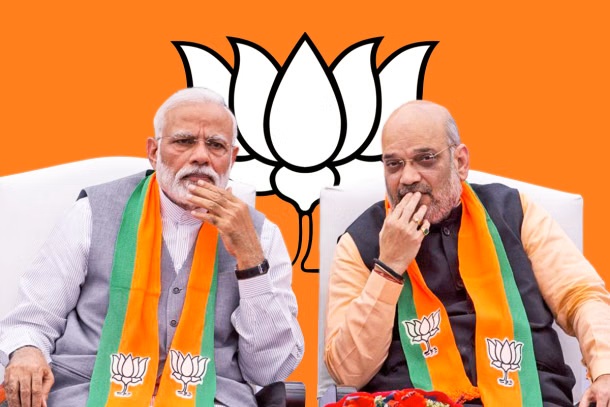
There are tell-tale signs that the BJP has been shaken to its core following the upsurge of protests by the country’s youths against the malfunctioning of its government. The BJP’s Central and most State gov’ts’ failure to address their problems in education, jobs, secure futures, and livelihoods has finally come home to the average citizens. The first indication was seen when the government sacked the Union Education Minister in the face of massive protest mobilisation at Jantar Mantar, Delhi led by the Cockroach Janta Party (CJP), which later spread across the country.
The government seemingly thought the protests would die down with the minister’s resignation. But the early gains enthused students and youths so much that they launched a bigger movement beginning from Independence Day this year, demanding proper school buildings instead of ramshackle ones, with minimum facilities such as good toilets and water across the country. The movement has gotten off to a flying start, with images of dilapidated school buildings, unhygienic or broken toilets and shabby roads making it difficult for rural children to traverse the distance from their homes to school being shared on social media by the CJP as also common citizens. The BJP realised the political and electoral impact the agitation may have and immediately swung into action by removing on 17 August, Amit Malviya as the head of its IT cell. He had been appointed to the post in 2015 under the party’s then national president Amit Shah, just a year after Narendra Modi became Prime Minister. He had fashioned the party’s social media campaign, dishing out different narratives in such a manner that the BJP’s propaganda machinery became formidable in creating absolutely false perspectives.
However, time took its toll. He, as some claim, apparently became brash and arrogant, ridiculing political opponents much above and beyond his station. As he enjoyed the blessings of the party’s top two bosses, he continued in the post and resorted to mocking the youths and common people instead of responding to their problems in a sensitive manner, which should have been the normal response for a ruling political party. This caused hostile criticism within the BJP and RSS, including RSS ideologue Ratan Sharda, for his disconnect with ground realities. Sharda had earlier upbraided Malviya for “trolling citizens” and had termed it a “serious problem.” At the time, Sharda advised Malviya to refrain from insulting people. Though many within the BJP praised Malvi ya’s ability for ‘narrative setting’, which helped the BJP stay ahead of its opposition, especially during elections, a section in the party felt that “certain boundaries” were being crossed. Malviya had in the past served as a national spokesperson too. With the groundswell of criticism of the Centre by the youth, BJP realised things are getting out of control and that it must try to reconnect with the country’s young people, who were being consolidated in an unprecedented manner by the circumstances created by CJP. Without wasting time, it replaced Malviya with a relatively unknown Deepak Mhaskey.
The phenomenal response the students movement has got and is continuing to get from millions of youths and students in the country appears to have created the impression that the BJP can no longer rely on the usual social media tools like WhatsApp, X and Facebook. Gen Z protesters used social media platforms like Instagram as a major rallying point, mocking Modi and his government through abuses, songs and videos. The BJP apparently wants to redesign its social media strategy to win back the massive constituency of the country’s youth. India has more than 50 per cent population below the age of 25 and over 65 per cent below the age of 35. The way such a large swathe of the population is growing hostile to the BJP-led government at Centre may spell disaster for the party, especially in the Lok Sabha elections in 2029. One thing is certain. Mere tinkering of social media outreach is not enough. It is also not easy to dominate video-based social media platforms such as Insta. With X (formerly Twitter), Facebook and WhatsApp, it was easier to remain hidden and aggressively abuse any and everyone who had the courage to speak up slightly against the BJP and its leaders. Many handles had fictitious names and photos, with their bio stating Sanatani, Deshbhakt and such clichéd words. Multiple accounts were being handled by the same set of people, and their language had a seeming uniformity. With their aggression and abuses, most opponents used to get scared. The protesting students outplayed the BJP’s IT cell language. The choicest of abuses were heaped on Modi himself, and the IT cell could only be a mute spectator.
On Insta, every young user showed her or his face and that caught the BJP off guard. The ruling party’s IT cell employees were unwilling or incapable to face the camera, get exposed and support Modi. Those who were using dirty words through nameless, faceless social media handles against opposition leaders and common citizens became the target of the dirtiest abuses themselves.
At their wits end, they have found Amit Malviya as the whipping boy. The days of social media game, hyper hate and divisive politics seem numbered now. Bringing back a screeching Smriti Irani or a failed Ram Madhav may not lift the leaking boat easily. What is needed now is positive action, not threats, by addressing the concerns of the youths perennially neglected by successive governments. The way education budgets have been slashed, curriculum perverted, and job opportunities shrinking under the BJP-led government during the past years, it is, in itself, an uphill task for the party to win back students and youths of India.