
The judiciary is one of the three pillars of Indian democracy that the people traditionally trust, most for the redress of wrongs. But over the years people’s faith in it has steadily eroded. Now, it is witnessing a crisis of faith like never before with some top judges of the highest court being perceived to be pronouncing verdicts in favour of the government without rhyme or reason.
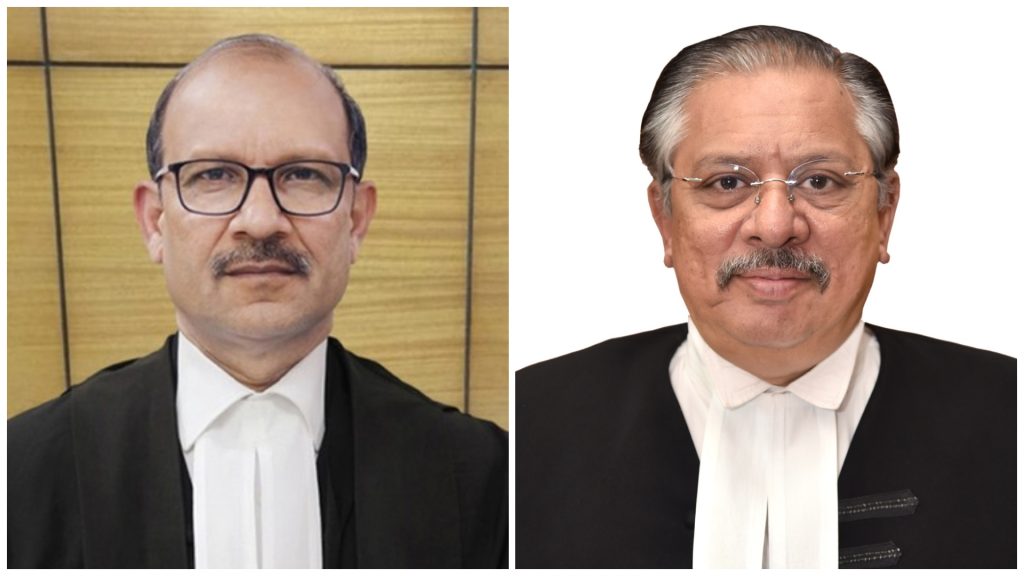
However, the latest disclosure of the judiciary not living up to its reputation appears appalling with a Supreme Court judge Justice Sandeep Mehta levelling serious and grave accusations of wrong-doing against the acting Chief Justice of Rajasthan High Court Sanjeev Prakash Sharma, who has just been relieved of his post. The charges range from listing of cases to benefit rich litigants to appointment of chosen favourites as court staff.
What is even worse is that when the accusations made by Justice Mehta are being examined “at the appropriate level,” a fourth letter with fresh allegations has come to light. In that letter to Chief Justice of India (CJI) Surya Kant, Justice Mehta claimed he has “further information and material regarding arbitrary, dubious and patently high-handed act” of Justice Sharma. It was only after the accusations were made public that a fulltime Chief Justice of Rajasthan High Court, Justice Sanjay Kumar Agarwal, was sworn in replacing Justice Sharma, who had been the acting CJ for nearly a year.
In his previous letters sent to the CJI on 2 August, 10 August and 17 August and copied to other members of the Supreme Court Collegium, Justice Mehta had accused Justice Sharma of “misuse of powers” and claimed he had received “several complaints,” which “raise doubts” on Justice Sharma’s “integrity.” Based on this, Justice Mehta had also sought transfer of the acting CJ to another High Court and the appointment of a new Chief Justice. In the fourth letter that has now come to light, Justice Mehta has accused Justice Sharma of interfering in an internal judicial enquiry, breaching confidentiality, and abusing administrative powers.
He also alleged arbitrary rule changes, judicial interference in a land dispute and broader corruption and administrative breakdown at the Rajasthan High Court. ‘Baseless’, said Justice Sharma in reply to the allegations against him. Justice Mehta’s claims about the way he has been fruitlessly pursuing the matter for the past few months put the judiciary in an even poorer light. He said he had been regularly interacting with the CJI regarding these “highly arbitrary, perverse and corrupt actions” of Justice Sharma for the last few months. But he regretted not much heed has been paid to his efforts to save the very credibility of the justice delivery system.
Such inaction, in his opinion, had only emboldened Justice Sharma to perpetuate his corrupt actions thereby causing grave damage to the institution. The allegations are so serious that any delay in probing them creates the impression of a rot that has seemingly set in in the judiciary.
Justice Mehta has claimed that Justice Sharma created certain posts with higher pay scales and misused discretionary powers of the Chief Justice to make appointments against some posts. In his three letters to the CJI, Justice Mehta gave specific instances of such irregularities.
He even claimed he has “credible information” that new posts have been created with exorbitant pay scales “without following the due process of law”. There are also allegations by a litigant of dubious court proceedings in connection with a pending land dispute case in Bundi district of Rajasthan.
The background of the whole controversy strengthens suspicion that all is not well within the judiciary. Justice Sharma was appointed a Rajasthan High Court judge in November 2016 and transferred to the Patna High Court in 2022.
In March 2023 the Collegium, headed by then CJI DY Chandrachud, declined his request to return to Rajasthan on health grounds. He was instead transferred to the Punjab and Haryana High Court. In May 2025, a fresh Collegium recommended his return to Rajasthan and he later became the acting CJ of the Rajasthan High Court.
In his letters, Justice Mehta wrote that Justice Sharma had held the position of acting Chief Justice for more than 10 months. During this period, Justice Mehta claims several judges of the Rajasthan High Court had approached him and expressed concerns about Justice Sharma’s conduct. Justice Mehta backed the accusations with a letter by the Rajasthan High Court Advocates’ Association to the CJI, which purportedly raised grave complaints about the arbitrary functioning of the Acting Chief Justice and demanded appointment of a regular Chief Justice in the Rajasthan High Court.
The whole episode is a sad commentary on the festering wounds that are seemingly affecting the judiciary like many other institutions of the country whose overhaul is long overdue. Unless and until the human element improves qualitatively, Indian judiciary and other institutions will never change in any manner simply by new rules and regulations.