


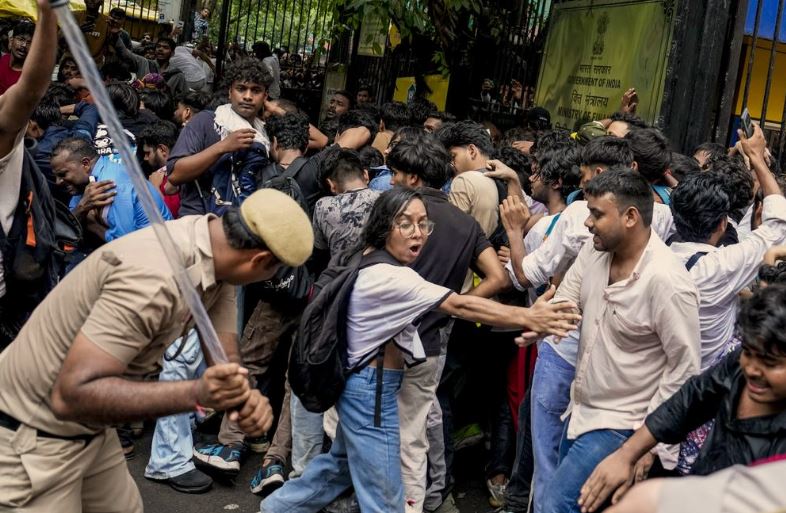
Better late than never. Two days after the resignation of Union Education Minister Dharmendra Pradhan, the Supreme Court has stated on 27 July 2026 that there cannot be police excesses or violence merely because there is an agitation. The three-judge Bench, headed by Chief Justice of India Surya Kant, was hearing a batch of petitions on police excesses, seen on camera and going viral on social media, against youths demonstrating at Jantar Mantar demanding the minister’s resignation and accountability from the government.
Funnily enough, it is the same CJI Surya Kant who has been credited to have helped coin the name of Cockroach Janata Party by calling the youth of India useless like parasites and cockroaches on 15 May 2026. In fact, CJP founder Abhijeet Dipke has thanked the role of CJI Surya Kant in helping spark the movement that finally led to the resignation of Dharmendra Pradhan.
At the height of the students-led agitation, Surya Kant made yet another controversial observation that the apex court had no time to waste on seeing videos of brutal police action against protestors. A pertinent question could be what made him change his mind on the same issue so quickly. The inescapable conclusion could be the country’s courageous youths have succeeded in jolting both the executive and the judiciary out of their stupor when people’s voice was being routinely stifled by the government through coercion, intimidation, police high-handedness and vindictive application of draconian laws such as the UAPA and sedition rules.
The police in BJP-ruled Bihar even used AK-47 to quell young agitators demonstrating in Patna on the same issue. Notably, the officer who had brandished that weapon has been suspended.
The volte face by the CJI came as a surprise. He observed that there should be a protocol in place and if aggrieved people want to agitate on an issue, they should be provided with a proper space. However, to make up and balance his position with the government the CJI also added that anti-social elements at such protests should be dealt with accordingly. He advised all sides not to take it in an adversarial manner and said that if there are excesses committed, those should be independently looked into and responsibility fixed. He even sought to offer the palliative that preventive measures and mandatory guidelines need to be spelt out to ensure such incidents do not recur.
On the other hand, it is heartening to observe that the voice of criticism on the functioning of the judiciary these days has been raised from within the judicial system itself. Senior advocates of the apex court have come out openly in support of the students and have even offered free legal assistance.
Justice Ujjal Bhuyan of the Supreme Court has questioned the practice of retired judges entering politics or accepting political appointments, saying the belief that a former CJI joining the Rajya Sabha could bridge the gap between the judiciary and the executive is “fundamentally wrong.” His remarks have reignited the debate on judicial independence, separation of powers and post-retirement appointments of judges which can suggest vested interest during earlier hearings.
Speaking at a public event, Justice Bhuyan emphasised that India’s constitutional framework is based on the separation of powers, with the legislature, executive and judiciary functioning independently while respecting each other’s constitutional roles. Using the analogy of a stool with three legs, he said if two legs are at one place, the stool will fall.
Slamming the former CJI’s remark, Justice Bhuyan said there is no constitutional “gap” between the judiciary and the executive that requires a retired judge to act as a bridge. Instead, each institution is expected to function independently within its own sphere while maintaining the constitutional system of checks and balances.
Crowd control measures used by security forces against protesters marching to Parliament have come under scrutiny, with many flagging the use of pellet guns, tear gas and lathis armed with nails.
Earlier, the Leader of the Opposition in Lok Sabha, Rahul Gandhi, wrote to the Home Minister, seeking accountability for the “barbaric assault” on student protesters.
After Pradhan’s resignation, the government has begun hunting down and terrorising student protesters, especially in Bihar, Assam and West Bengal. The CJP has expressed concern over such targeted detention by state authorities saying it has called off its nationwide protest only after assurance by the Central government that no punitive action will be taken against any protester. The CJP has warned of fresh agitation if crackdowns and arrests continue.
At this stage, the role of judiciary is set to be tested to its highest degree. It remains to be seen if, with the likes of CJI Surya Kant and others like him at the top through to the bottom, the judiciary can live up to its purported role of protecting the tenets of democracy and holding the executive accountable.