
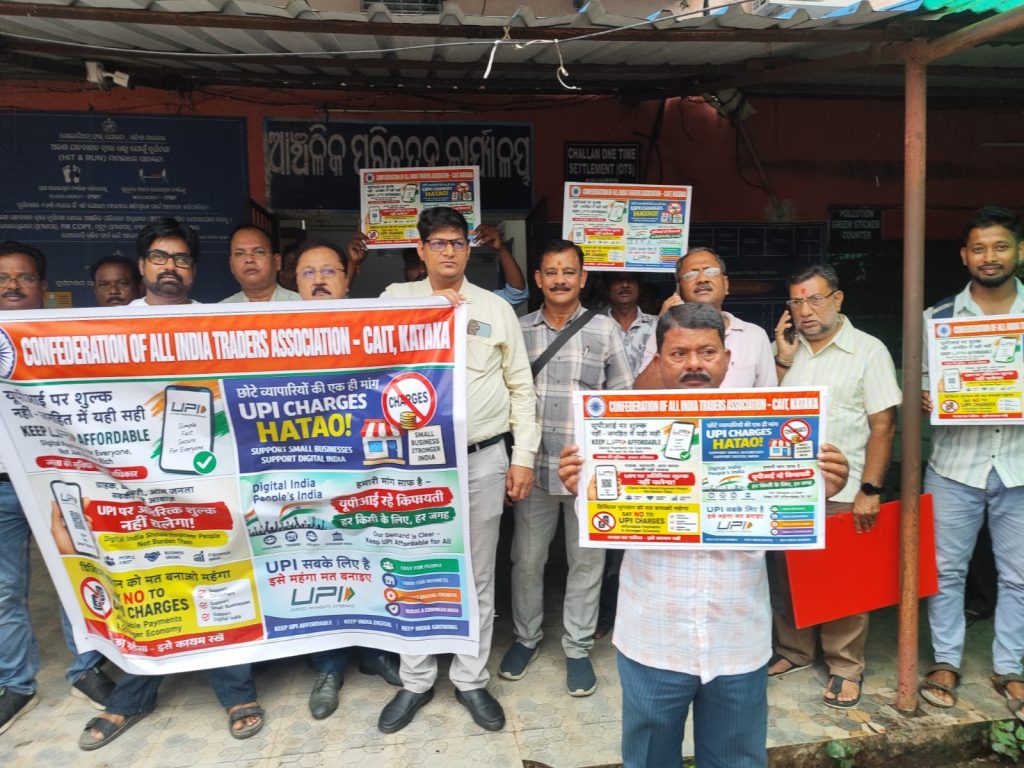
Kataka: Members of the trading community, led by the Confederation of All India Traders (CAIT), District Kataka, staged a peaceful demonstration before the Collectorate Thursday, opposing the proposed 0.4 per cent Merchant Discount Rate (MDR) on UPI merchant transactions above Rs 2,000.
The traders submitted a memorandum to the Collector and District Magistrate, Kataka, seeking its transmission to the Union Finance Minister for consideration. The memorandum stated that UPI has become a key component of India’s digital payment ecosystem and is widely used by traders, retailers, MSMEs and consumers because of its convenience, speed and accessibility.
The traders argued that imposing an MDR could increase the cost of digital transactions, particularly for businesses handling a large volume of payments. According to the memorandum, a 0.4 per cent MDR would amount to Rs 20 on a transaction of Rs 5,000, Rs 80 on Rs 20,000 and Rs 300 on Rs 75,000. It further stated that, if 18 per cent GST were applicable to the MDR, the combined burden could reach 0.472 per cent of the transaction value, subject to applicable input-tax credit provisions. The trading community also expressed concern that charging for UPI transactions could encourage some businesses and consumers to rely more heavily on cash payments. The memorandum argued that this could run counter to efforts aimed at promoting transparent and traceable digital transactions.
Traders highlighted existing expenses related to GST and income-tax compliance, accounting and professional services, banking charges, digital infrastructure, manpower and other statutory requirements. They said an additional transaction-linked cost could further affect businesses operating on relatively narrow margins. The memorandum urged the government to reconsider the proposed 0.4 per cent MDR, consult traders, MSMEs, banks and payment-system stakeholders, and explore alternative mechanisms to support the digital-payment ecosystem. It also called for stronger measures to address unaccounted transactions, tax evasion, black money and large cash dealings rather than increasing the cost of digital payments.
Orissa POST – Odisha’s No.1 English Daily