
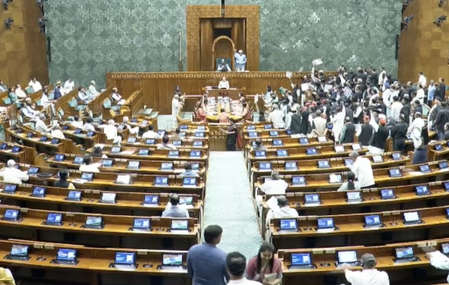
New Delhi: Lok Sabha Friday passed the Registration of Births and Deaths (Amendment) Bill, 2026, amid Opposition protests over the police crackdown on students during the July 20 Parliament march, with the legislation being cleared without a debate.
The bill was taken up for consideration and passage after the House reassembled at noon with BJP MP Dilip Saikia in the Chair. It was passed by voice vote amid sloganeering by Opposition members, several of whom trooped into the Well demanding the presence of Home Minister Amit Shah in the House.
Parliamentary Affairs Minister Kiren Rijiju expressed displeasure over the Opposition’s refusal to participate in the debate, saying the government wanted a discussion on the “important Bill”.
Also Read : Vande Mataram Bill cleared in LS, insulting national song to become criminal offence
“It is unfortunate. Please do not repeat this in the future. People who sent you to Parliament will seek answers from you,” Rijiju said, urging Opposition members to participate in debates on future legislation instead of creating disruptions.
Saikia also said it was “unfortunate” that the bill had to be passed without the cooperation of Opposition members.
Soon after its passage, the House was adjourned for the day.
The bill seeks to amend provisions of the Registration of Births and Deaths Act, 1969, to encourage timely reporting of vital events.
The bill seeks to make delayed registration of births and deaths more stringent by requiring an order from a judicial magistrate (first class) for registrations made more than two years after the event.
Under the existing law, registrations delayed by more than one year require an order from a district magistrate, sub-divisional magistrate, or an authorised executive magistrate, and the provision will continue to apply for delays of up to two years under the amended law.
The legislation was cleared for introduction by the Union Cabinet July 20 and proposes further changes to the delayed registration process following amendments made to the parent Act in 2023.
The bill also updates legal definitions, aligning the term “executive magistrate” with the Bharatiya Nagarik Suraksha Sanhita, 2023, replacing previous references to the 1973 Code of Criminal Procedure.
With the passage of the bill in Lok Sabha, the government has pushed through another piece of legislation amid disruptions in Parliament during the Monsoon Session.
So far, two bills — the Public Examinations (Prevention of Unfair Means) Amendment Bill, 2026 and the Prevention of Insults to National Honour (Amendment) Bill, 2026 — have cleared both Houses of Parliament in the current session.
The Registration of Births and Deaths (Amendment) Bill, 2026 now awaits Rajya Sabha approval.
During the proceedings, BJP MP Aparajita Sarangi, who chairs the Joint Parliamentary Committee examining the Constitution (130th Amendment) Bill, 2025, was granted an extension for the panel’s report till the first day of the last week of the Winter Session.
Orissa POST – Odisha’s No.1 English Daily