
Imphal: For the first time since ethnic violence erupted in Manipur in May 2023, security forces have taken control of a camp meant to house Kuki-Zo militants under a nearly two-decade-old truce and plan to audit all 14 such camps across the state, top security officials said on Saturday.
This rare takeover followed the discovery that only one of the 159 registered cadres was present at the camp, raising questions about compliance with the Suspension of Operations (SoO) agreement, which expired September 4 without renewal.
The move also comes days after the October 19 killing of three Meitei civilians near Nongshum.
There have been longstanding demands by Meitei organisations for the closure or relocation of SoO camps and the abrogation of the agreement, amid allegations that militants covered by the truce have attacked civilians and security forces.
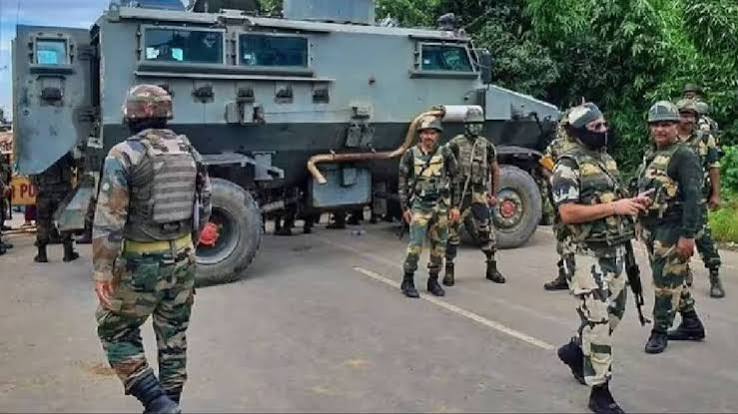
Joint teams of Manipur Police and the Central Armed Police Forces took complete charge of Sinai in Kangpokpi district Saturday following security operations launched in the aftermath of the Nongshum killings, the officials said.
“The raid was carried out Friday and security forces took complete control of the camp Saturday. The exercise will continue. All the designated camps will be audited to find out the ground reality,” a senior security official told the media Saturday, hours after the takeover of the Sinai camp.
At Sinai, security personnel found only one registered cadre against an “expected strength of 159”, along with 17 people who were not identified as cadres covered by the agreement. The 17 were arrested Saturday, the official said.
“All 17 accused have been remanded to eight police custody till October 31. Further investigation is underway regarding the involvement of camp functionaries, impersonation, unauthorised possession of arms and violations of SoO ground rules,” Manipur Police said in a statement on Saturday.
The forces seized 24 firearms, 38 magazines, a large quantity of ammunition, explosives, wireless communication equipment and other combat gear from the camp, the statement added.
The senior official said explanations for the missing cadres included claims that some had gone home while others were elsewhere, adding that a thorough investigation was underway to verify their whereabouts.
Asked whether the agreement’s expiry meant militants could now leave their camps, the senior security official said this would not be permitted because the arrangement had not been abrogated either.
“The decision on whether or not the SoO agreement should be renewed lies with the Centre, but as long as it is not abrogated, the cadres and their weapons must remain in the designated camps,” the official said.
The discrepancy raises questions about compliance with one of the central conditions of the SoO agreement – that militants covered by it must remain in designated camps and refrain from violence.
The agreement, formally signed by the Centre, the Manipur government and Kuki-Zo militant groups in August 2008, was intended to suspend hostilities and create conditions for a negotiated political settlement while keeping armed cadres confined to designated camps.
Its origins date back to 2005, when the Indian Army reached an understanding with Kuki militant groups to suspend operations against each other.
The pact covers Kuki-Zo militant groups under two umbrella organisations – the Kuki National Organisation (KNO) and the United People’s Front (UPF).
Under its ground rules, cadres are required to refrain from violence, remain in designated camps and keep their weapons under prescribed security arrangements.
The arrangement has been central to the Centre’s efforts to address Kuki-Zo insurgency through negotiations, but its continuation has become increasingly contentious since the outbreak of ethnic violence in May 2023.
In February 2024, the Manipur Assembly adopted a resolution seeking abrogation of the agreement. Naga organisations have also demanded its termination, accusing Kuki-Zo militant groups of involvement in violence.
Unlike routine inspections or verification of cadres, the Sinai operation has placed a designated militant camp under the direct control of security forces, marking a significant departure from the monitoring mechanism envisaged under the truce.
The decision to extend verification to every designated camp also widens the operation beyond the investigation into the Nongshum killings.
The statewide audit is expected to reveal whether the massive discrepancy found at Sinai is an isolated case or reflects a wider breakdown in compliance with the truce.
Manipur Home Minister Govindas Konthoujam said Friday that the SoO agreement had expired September 4 and had not been renewed. He suggested that public opposition to its continuation could be a reason for the delay.
The killings near Nongshum have heightened tensions between the predominantly valley-based Meitei and hill-based Kuki-Zo communities, whose conflict since May 2023 has left hundreds dead and thousands displaced.
Police have arrested three suspects in connection with the killings. Two allegedly admitted participating in the attack, according to officials.
Konthoujam said Friday that security operations would continue irrespective of community and would cover camps associated with Kuki, Meitei and Naga groups.