
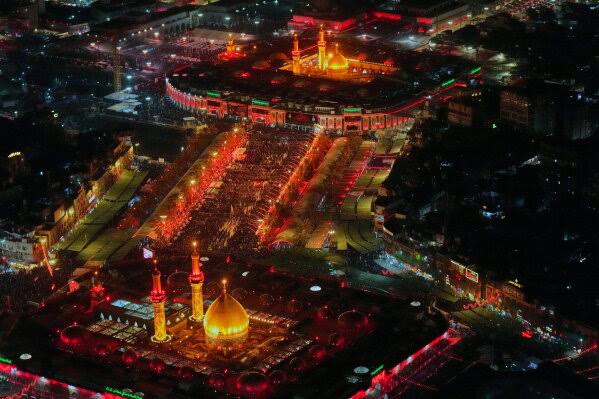
Baghdad: Millions of Shiite Muslims observed the annual Arbaeen pilgrimage Tuesday in the Iraqi holy city of Karbala, under the shadow of ongoing regional tensions and fears of another round of escalation in the US-Iran war.
Arbaeen is held 40 days after Ashoura, which commemorates the killing of Imam Hussein, grandson of the Prophet Muhammad, and members of his family, at the Battle of Karbala in 680 AD.
The operations command overseeing the Arbaeen pilgrimage at the Office of the Commander-in-Chief of the Armed Forces said Monday that more than 4.88 million pilgrims had entered Iraq since the first day of the Islamic month of Muharram, which includes Ashoura and the period leading up to Arbaeen, with arrivals from various countries ongoing for what is considered one of the world’s largest annual religious gatherings.
Millions more pilgrims typically come from different regions of Iraq to Karbala for the occasion.
Among the highest- profile foreign visitors was Iranian Foreign Minister Abbas Araghchi, who arrived in the Iraqi city of Najaf Monday and continued on to Karbala to take part in the pilgrimage.
Araghchi’s presence was a reminder of the delicate balancing act Iraq — which has close ties to both Washington and Tehran — has carried out since the beginning of the war. Iraq has found itself in the crosshairs of both sides and has sought to avoid getting pulled further into the conflict.
As usual, Iranian pilgrims arrived in large numbers, but some observers said the number of pilgrims from other countries had shrunk.
Aqeel al-Rubaie, 45, a pilgrim from Baghdad who was on his way to Karbala, said Iranian flags were particularly visible along the Najaf-Karbala road, while there were fewer flags than usual from European, Arab and other Islamic countries.
He attributed this to the war and the events unfolding across the region, which have affected the number of Arab and foreign pilgrims.
Another pilgrim from Baghdad, Hassan al-Sarai, 35, said, I hardly saw any flags other than Iranian ones, which were clearly visible along the road as well as inside and around the city of Karbala.
Volunteer processions providing food, water, medical care and other services lined the roads leading to Karbala from across Iraq.
The pilgrimage is taking place this year as Iraq faces difficult economic conditions following the war and the closure of the Strait of Hormuz, which has disrupted Iraqi oil exports. More than 90 per cent of Iraqi state revenues come from oil exports, making the country’s economy highly vulnerable to any interruption in crude shipments.
It also comes as Baghdad is wrestling with a difficult task it has set for itself: disarming the country’s network of militias, many of them Iran-backed.
One of the most powerful Iran-backed militias, Kataib Hezbollah, said in a statement marking the occasion of Arbaeen that it rejects calls to disarm and remains committed to retaining what it described as the weapons of the resistance.