

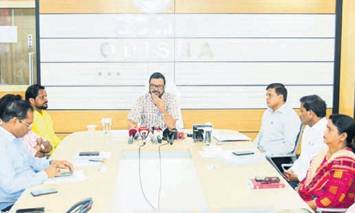
Bhubaneswar: With the winter session of the State Assembly set to begin November 18, Revenue and Disaster Management Minister Suresh Pujari Thursday invited all political parties to a comprehensive discussion on Odisha’s disaster management preparedness, tracing the journey from the 1999 Super Cyclone to the present.
Addressing a press conference here, Pujari said the government was open to constructive criticism and debate on its response to natural disasters, including cyclones Dana, Montha and Arnab. Highlighting the unprecedented rainfall during Cyclone Arnab, he said Patrapur block in Ganjam district recorded 546 mm of rainfall in 24 hours October 29, the fourth-highest single-day rainfall in Odisha’s recorded history.
The extreme downpour triggered flash floods across Ganjam and adjoining districts. Ganjam received an average of 337.6 mm rainfall between October 28 and 30, with daily figures of 83.1 mm, 191 mm and 63.4 mm, respectively.
Patrapur alone recorded 808.4 mm during the period. Other severely affected areas included Sanakhemundi in Ganjam (560 mm), Mohana in Gajapati (525.2 mm) and G Udayagiri in Kandhamala (543.2 mm). On October 29, G Udayagiri received 462.4 mm, followed by Sanakhemundi (388 mm), Raikia (384.8 mm), Sorada (375 mm), Chikiti (309.2 mm) and Rangeilunda (261 mm). Pujari said heavy rainfall across Ganjam, Gajapati and Kandhamala triggered flash floods in the Rushikulya and Budhabalanga river systems.
Explaining the challenges in managing the Rushikulya, he said four dams and several tributaries form part of the system. The absence of gates at Sorada created difficulties during the floods, and the government was exploring solutions.
Citing improvements in disaster management, Pujari said the 1990 Super Cyclone claimed 9,866 lives, compared with 45 during Cyclone Phai lin (2013), 72 during Cyclone Titli-related floods (2018) and 65 during Cyclone Fani (2019). He claimed there were no direct deaths in Ganjam due to Cyclone Arnab and subsequent floods, while casualties were attributed to landslides.
The government is consulting scientific and technical institutions to strengthen landslide management. Pujari said the relief package covers agricultural land, houses, household belongings and businesses. Each affected family is entitled to 50 kg of rice and Rs 2,500 as immediate assistance.