


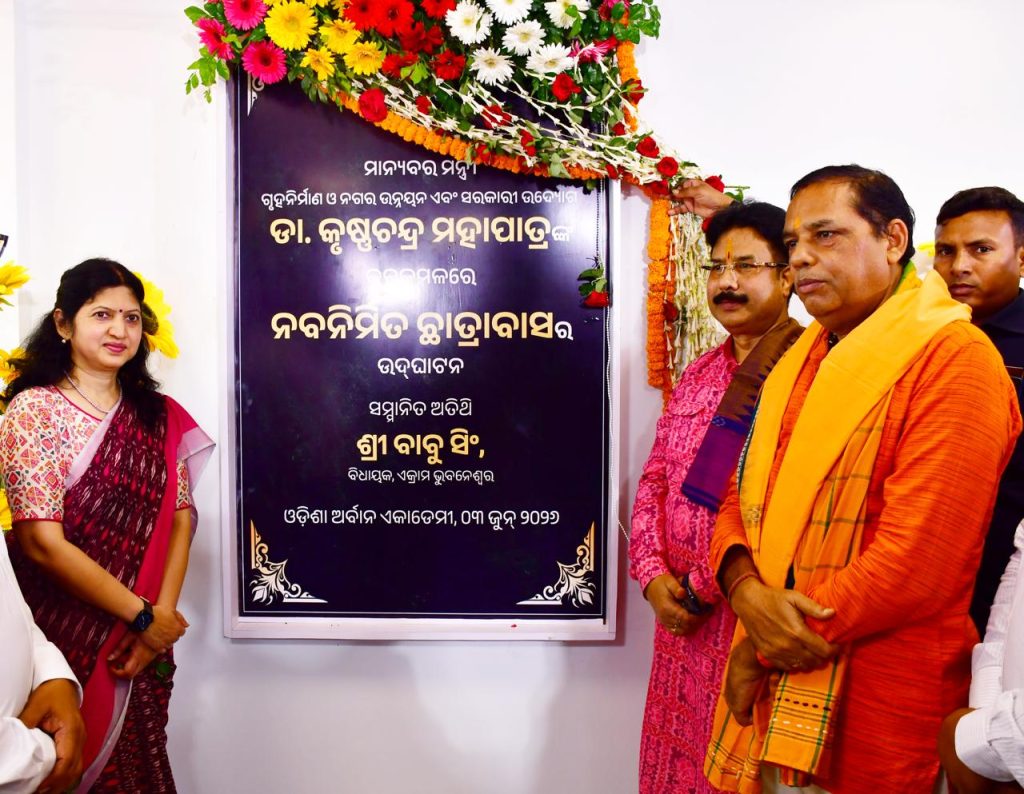
Bhubaneswar: In a move aimed at enhancing institutional capacity and fostering a future-ready urban governance framework, Housing and Urban Development Minister Krushna Chandra Mahapatra Wednesday inaugurated the newly constructed hostel of the Odisha Urban Academy (OUA) at Basuaghai.
Ekamra-Bhubaneswar MLA Babu Singh, Department Additional Chief Secretary Usha Padhee, WATCO Managing Director Debabrata Mohanty and other senior officials were present on the occasion.
Mahapatra also unveiled the Annual Training Calendar of the OUA, reaffirming the state government’s commitment to continuous learning, professional development and institutional excellence in the urban sector.
He underscored the critical role of capacity building in achieving state’s ambitious urban development goals.
He stated that strong institutions and skilled human resources are essential for delivering efficient, citizen-centric urban services and addressing the emerging challenges of rapid urbanisation.
The minister noted that the OUA has evolved into a unique urban learning hub equipped with practical demonstration facilities such as a Sewage Treatment Plant (STP), Septage Treatment Plant (SSTP), and Material Recovery Facility (MRF).
These facilities provide hands-on exposure to modern urban sanitation, waste management and water reuse practices.
“Participants can learn how treated wastewater can be reused and gain practical knowledge of sustainable urban management systems.
People from different states and even other countries can come here for training. With the inauguration of this hostel, a larger number of trainees can now stay on campus and benefit from the Academy’s training programmes,” the minister said.
Constructed at a cost of Rs 9.45 crore, the OUA hostel has been developed as a dedicated residential facility to support trainers, trainees, urban professionals, elected representatives and other stakeholders participating in various capacity-building, training, research and knowledge-sharing programmes conducted by the Academy.
Designed to provide a comfortable, functional and learner-centric environment, the hostel can accommodate 56 residents through 28 twin-sharing rooms, including 24 standard rooms and four premium rooms, each equipped with attached toilets and balconies.
The facility also includes a reception and administrative area, a dining hall with seating capacity for 40 persons, a modular kitchen, guest rooms, common utility spaces, spacious lobbies and community interaction areas.
To facilitate high-quality residential training programmes and workshops, the hostel houses a fully equipped conference hall, along with a gymnasium and indoor recreation facilities, ensuring a holistic and enriching experience for participants.