
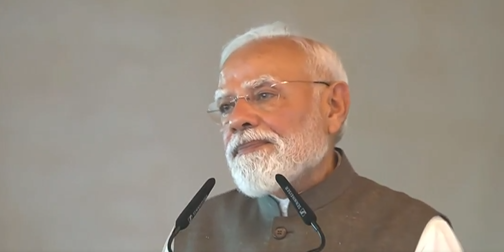
New Delhi: Prime Minister Narendra Modi Thursday pitched India as a trusted alternative for global manufacturing, telling chip industry leaders that his government is taking every step necessary to make the country a preferred semiconductor destination.
The world is looking for new and trusted manufacturing destinations; India is steadily preparing itself to meet this need, Modi said, inaugurating the fifth edition of the SEMICON India conference here. India is taking every step needed to become a preferred destination for the semiconductor industry.
The prime minister paired the pitch with news that Indian-made chips have begun reaching customers for the first time. Now our chips, coming out of India’s plants, have started reaching customers in the country and the world, he said.
He framed the push within a broader narrative of economic momentum, citing 7.8 per cent quarterly GDP growth, a recent sovereign rating upgrade by a Japanese credit rating agency, and the New Delhi Declaration adopted at the BRICS summit India hosted this month.
India’s economy is growing, and on the other hand, the world’s trust in India is also increasing, he said.
He credited industry leaders present at the conference with anchoring the ecosystem’s rapid build-out since the mission’s 2022 origins. You are the pillars of this success of India, you are partners, Modi said.
He also highlighted progress in India’s semiconductor programme since its launch in 2022, saying the sector had moved from policy formulation and project planning to pilot production and commercial manufacturing. He said chips manufactured in India had begun reaching customers in India and overseas, while commercial production had started at new plants in Mohali and Surat.
The prime minister said the development of a semiconductor ecosystem required capabilities spanning chip design, equipment, materials, testing and packaging. He urged industry leaders to deepen domestic research and development and encouraged Indian researchers working overseas to contribute to advanced technology development in the country.
Young talents who are researching in India should come forward; the youth who are researching abroad should also join the development of advanced technologies in India, Modi said.
He called on semiconductor companies to expand research partnerships with Indian institutions and universities, saying greater industry-led R&D would benefit both companies and the country’s technology workforce.
Modi said the government was advancing the second phase of its semiconductor programme and had introduced regulatory changes intended to facilitate collaboration among global companies, startups and design firms. The government approved the second phase of the Semicon India programme in July with an outlay of Rs 1.275 lakh crore.
The prime minister also called for a deeper domestic supply chain, including more fabless semiconductor companies, locally developed intellectual property and greater use of silicon photonics for artificial-intelligence infrastructure.
He urged companies producing semiconductor equipment, chemicals, gases and materials to expand in India, saying the country had an opportunity to build an ecosystem spanning the semiconductor value chain.
Modi pointed to India’s engineering workforce as a key advantage, saying the government was targeting to train 100,000 engineering students in chip design and related fields. He said about 70,000 had already been trained.
The prime minister also linked the semiconductor push to India’s growing energy requirements, particularly from artificial-intelligence data centres and advanced manufacturing facilities. He said India was expanding its power-generation capacity, including solar and nuclear energy, to support the needs of high-performance computing and industrial production.
SEMICON India 2026, themed Silicon to Systems Building the Ecosystem, is being held from September 17 to 19 and brings together semiconductor companies, policymakers, investors, academics and startups.
Modi said India’s growing semiconductor capabilities would strengthen global supply chains and invited international companies to expand their operations and partnerships in the country.
The first phase of the semiconductor mission, launched in 2021, was largely aimed at proving India could attract fabrication and packaging investment. The government committed roughly Rs 76,000 crore and ultimately approved 12 semiconductor manufacturing projects worth more than Rs 1.64 lakh crore across six states Gujarat, Assam, Uttar Pradesh, Punjab, Odisha and Andhra Pradesh, spanning a silicon fab, a silicon carbide fab, a gallium nitride micro-LED display fab, and nine assembly, test, mark and packaging facilities. Three companies – Micron, Kaynes and CG Semi – have already begun commercial production, with another facility expected to go online later this year.
Industry estimates suggest the second phase could generate 150,000 to 200,000 direct and indirect jobs as it shifts focus from fabrication towards equipment, materials, chip design IP and advanced nodes. India currently imports close to 90 per cent of its chip requirements, at an estimated cost of USD 30 billion a year, and the government has set a target to build a USD 200 billion domestic semiconductor market.
SEMICON India 2026, organised by industry group SEMI alongside the mission and the electronics ministry, has drawn more than 500 exhibitors, including 243 international firms, and delegates from over 40 countries.
Modi also pointed to India’s expansion in solar and nuclear power capacity as critical to meeting the energy demands of AI data centres and chip plants.