
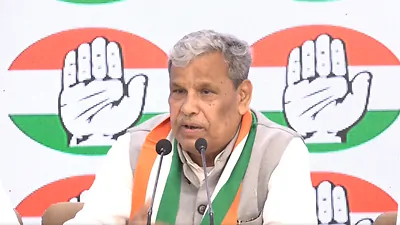
Bhubaneswar: Odisha’s investment priorities must focus on meaningful employment, sustainable resource use and environmental protection—not merely corporate investments that primarily benefit corporations, said former Union minister Srikant Jena in a letter to Chief Minister Mohan Charan Majhi seeking clarification over the proposed Rs 1.04 lakh crore data centre project at Naraj, raising concerns over its massive electricity and water requirements, environmental impact, employment generation and the concessions that may be extended to the investor.
In a letter to the CM, Jena said the state government had approved 27 projects involving a proposed investment of Rs 2.47 lakh crore at the 46th High-Level Clearance Authority (HLCA) meeting September 23, 2026, following the CM’s visit to Abu Dhabi. Among them was the Adani-linked High Density Data Centre Limited project at Naraj, reportedly spread over around 250 acres with a proposed capacity of 1 GW (1,000 MW).
Jena said the project’s memorandum of understanding (MoU), detailed HLCA minutes and related agreements covering power supply, water consumption, environmental clearances and tax concessions were not available in the public domain. He urged the government to disclose these documents in the interest of transparency and public accountability.
Questioning the project’s electricity requirements, Jena said a 1,000 MW data centre operating at full capacity could consume around 2.4 crore units of electricity a day. He sought details of the proposed power sources and asked whether the project would rely on coal-fired electricity, potentially increasing its environmental footprint.
He also questioned whether the company would receive subsidised electricity, free land and water, or long-term tax exemptions, citing reports of incentives associated with a proposed data centre project in Visakhapatnam.
Jena asked the government to clarify the terms of any such concessions and explain how the benefits to the investor would translate into tangible gains for the people of Odisha.
Raising concerns over water security, Jena questioned how the estimated requirement of 30 million litres of water per day would be met without affecting drinking-water supplies and agricultural needs.
He pointed to the existing water-supply deficit in Bhubaneswar, declining groundwater levels due to excessive borewell extraction and reported water stress in parts of the Mahanadi river system and adjoining canal networks.
Jena also questioned whether the proposed investment would generate adequate employment for local people, particularly when Odisha continues to face unemployment and work-related migration.
Although the project is expected to create around 1,000 jobs, he argued that data centres generally require fewer permanent employees than labour-intensive industries, with much of the workforce engaged in engineering, maintenance and security.
Expressing concern over noise, heat, air pollution and water consumption associated with large data centres, Jena sought to know whether an independent environmental impact assessment had been conducted and whether its findings would be made public.
He urged the government to explore alternative sites where seawater could potentially be used for cooling, alongside renewable energy sources such as solar and wind power, subject to technical and environmental feasibility.