
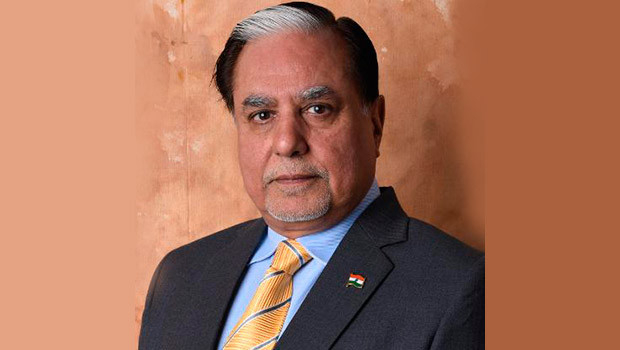
New Delhi: A five-member special bench of insolvency tribunal NCLT Tuesday barred Essel Group chairman Subhash Chandra from alienating his properties and issued notices to all parties in a case over a proposed settlement that would allow creditors to recover just about Rs 6.5 crore from his personal estate against claims of roughly Rs 22,006 crore.
The special bench of the National Company Law Tribunal (NCLT), headed by President Justice Anupinder Singh Grewal, said there was no majority view among its members and therefore, no final order could yet be given effect to.
“Let notice be issued to all the parties,” the bench said, directing that the guarantor “shall not alienate the properties, either directly or indirectly”.
Justice Grewal said the tribunal wanted to understand the scope of the matter and would hear all parties, including creditors who have opposed Chandra’s repayment plan.
The case is now also before the National Company Law Appellate Tribunal (NCLAT), after dissenting lenders challenged the repayment plan.
NCLAT took up the matter Tuesday and directed that it be listed Wednesday following a request by Solicitor General Tushar Mehta, appearing for LIC Housing Finance, Canara Bank and Union Bank, among others.
Mehta requested the appellate tribunal to grant one day’s time to decide whether they want to proceed in this matter or not.
Also Read : In personal insolvency case before NCLAT, Subhash Chandra opposes formation of 5-member NCLT bench
He also apprised a three-member bench of the appellate tribunal comprising its Officiating Chairperson Justice Yogesh Khanna, and said he will “examine the matter and come back” on Wednesday.
The dispute centres around a repayment plan under which Chandra was allowed to settle claims arising from personal guarantees on his group’s borrowings for just Rs 6.5 crore – a 99.9 per cent haircut on the Rs 22,006 crore his companies have defaulted on.
Ten banks and lenders had supported the proposal, while dissenting creditors including HDFC Bank, LIC Housing Finance and Canara Bank opposed it on the grounds that the recovery would be negligible. The dissenting lenders accounted for less than 20 per cent of the voting share.
Chandra has argued that the widely cited Rs 22,006-crore figure does not represent the money he personally borrowed. Instead, he says it comprises claims arising from guarantees he gave for loans raised by Essel Group companies. He has put the personal guarantee claims at about Rs 3,990 crore, saying the larger figure relates to claims against the underlying corporate borrowers.
Last week, while allowing for the settlement NCLT had opined that proceeding with bankruptcy against Chandra could leave the creditors with an even lower recovery. Its order also noted that his estate “comprises very few assets with negligible value”.
Dissenting lenders have, however, sought further scrutiny of Chandra’s declared net worth, which they say was a key basis for extending the guarantees. Certified figures put his net worth at about Rs 40,600 crore in 2018 and Rs 45,900 crore in 2017, according to the lenders, while the figure had fallen sharply by 2024.
The proceedings began after a two-member NCLT bench comprising Ashok Kumar Bhardwaj, Member (Judicial), and Reena Sinha Puri, Member (Technical), delivered a split verdict on the repayment proposal. The matter was then referred to a third member, whose decision to allow recovery of about Rs 6.5 crore from Chandra’s personal estate was challenged by the dissenting creditors before NCLAT.
“It is manifest that as per section 419(5) of the Companies Act, there is no clear majority view capable of being given effect to. Therefore, the order dated 25th August, 2026 of the third member, Shri Nilesh Sharma, Member (J) is stayed,” the bench said Tuesday.
Chandra, once one of India’s most prominent business figures, built interests spanning television, packaging, infrastructure and direct-to-home television. He was also elected as a Rajya Sabha Member of Parliament on the backing of BJP.
His business empire came under severe pressure following the 2018 liquidity crisis, which erupted after the collapse of infrastructure financier IL&FS. Essel Group companies, which had accumulated substantial debt, struggled to refinance their obligations as funding conditions tightened.
Much of the group’s debt was secured against pledged shares. A sharp decline in share prices triggered margin calls and further share sales, exacerbating pressure on the group. Some businesses were subsequently sold, while others entered insolvency proceedings.
PTI